



![Cover [EN]](https://investingbot.io/wp-content/uploads/2026/07/cover-en-cQ6q0.png)
If you search for an ETF on the S&P 500, you’ll find yourself faced with twenty nearly identical products: same index, same exposure, returns within a decimal point of each other. The right choice isn’t simply the one with the lowest TER: what matters is the actual replication difference (often more than the stated cost), size and liquidity, replication type, domicile and taxation, distribution policy, and currency. A cheap ETF that’s small or inefficient at replicating can perform less well than one that costs a few basis points more. In this article, we’ll examine, one by one, the criteria that truly distinguish one ETF from another on the same index.
Why are there twenty ETFs on the same index?
An index like the S&P 500 or the MSCI World is public: any provider can create a fund that replicates it. Thus, iShares, Vanguard, Amundi, Xtrackers, Invesco, SPDR, UBS, and others all offer their own versions of the same exposure. This is excellent news for investors—competition has lowered costs to almost symbolic levels—but it turns choice into a matter of detail: the products appear interchangeable, and the differences are hidden in the line items almost no one reads.
The good news is that the criteria that matter are few and measurable. Let’s look at them in order of practical importance.
1. TER isn’t everything: look at the replication difference
The TER (Total Expense Ratio) is the declared annual cost, and it’s the first number everyone compares. But the TER is a theoretical cost: what really matters is how much the fund deviates from its index over time, that is, the tracking difference. An ETF can recover part of its cost—or even beat the index after expenses—through securities lending, tax-efficient dividend management, or optimized replication.
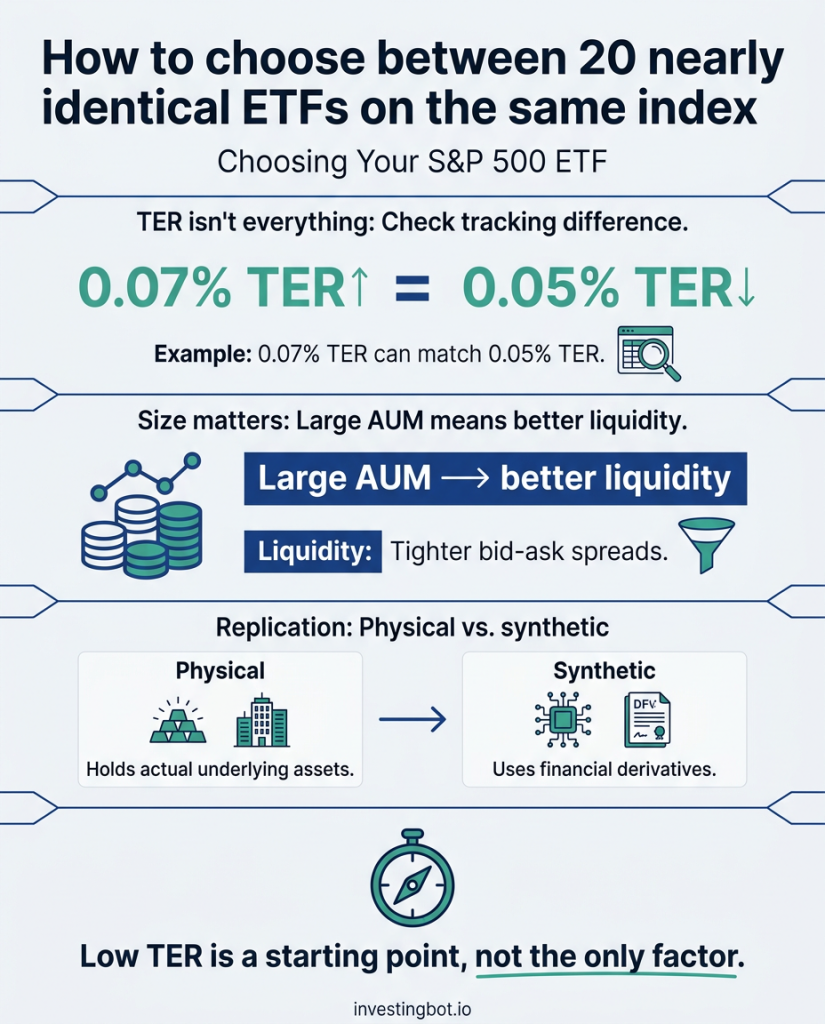
A concrete example: on the S&P 500, an ETF with TER of 0.07% may achieve the same net return as a competitor with a TER of 0.05%, because its tracking efficiency has exactly offset the 2 basis points of additional cost. Over the same period, however, another ETF with a TER of 0.03% may have outperformed both. The lesson is twofold: the lowest TER doesn’t automatically win, but the tracking difference varies from year to year and from manager to manager —no one can guarantee in advance who will be the most efficient. Therefore, all else being equal, a low TER remains the most solid starting point.
2. Size and liquidity
Assets under management (AUM) and trading volumes matter more than they seem. A large fund has tighter bid-ask spreads (you pay less to buy and sell), is less at risk of closure due to insufficient assets, and generally replicates the index more efficiently. On large indices, you can find ETFs with tens of billions in assets: they are the most liquid and reliable choice for a long-term investor. A tiny ETF on the same index, even if it has the lowest TER in its category, is more fragile: if it doesn’t raise assets, the issuer can liquidate it, forcing you to sell at a time you did not choose.
3. Physical or synthetic replication
An ETF can replicate the index in two ways. In physical replication, the fund actually buys the index stocks (all of them, or a representative sample): maximum transparency, zero counterparty risk. In synthetic replication, the fund doesn’t hold the stocks but enters into a swap contract with a bank, which guarantees the index’s performance in exchange for a basket of collateral. Synthetic replication can have a very low tracking error and is useful in less accessible markets (certain commodities, certain emerging markets), but it introduces counterparty risk (UCITS regulations limit it to 10% of assets). For a liquid and easily accessible index like the S&P 500, many investors prefer physical replication for peace of mind; for difficult exposures, synthetic replication may be the more efficient choice.
4. Domicile and taxation
Where a fund is domiciled affects its returns. Most European UCITS ETFs are domiciled in Ireland or Luxembourg. For ETFs investing in US stocks, Irish domicile enjoys a tax treaty with the United States that reduces the withholding tax on dividends from 30% to 15%: a silent but real advantage that accumulates over time. This isn’t a universal rule—it depends on the underlying market—but it is a factor that explains why two ETFs on the same index can diverge by a few basis points per year even with the same declared cost.
Then there’s the taxation for you as an investor: in many jurisdictions, capital gains on equity ETFs are taxed at a rate (in some, 26%; in others, a reduced rate for government bonds or whitelists). Always check the rules in your jurisdiction: this factor affects your net return as much as part of the cost.
5. Accumulation or distribution
Accumulating ETFs automatically reinvest dividends in the fund; distributing ETFs pay them periodically. One or the other isn’t necessarily better; it depends on your objective. For a long-term investor who’s accumulating, the accumulating version is often more efficient because it defers tax liability until the sale and reinvests without any costs or decisions. Those seeking an income stream (for example, in retirement) may prefer the distribution option. You’ll almost always find both versions on the same index: choose based on what you need, not what “yields more.”
6. Fund currency and hedging
Be careful not to confuse three different things. The quoted currency (in which you buy the ETF on the stock exchange) does not affect the return in your account currency: an S&P 500 quoted in dollars or euros performs the same if it is unhedged. The underlying currency does: an ETF on the S&P 500 exposes you to the euro/dollar exchange rate, which can help or hurt you. Currency hedging (the “hedged” version) neutralizes that risk, but it comes at a cost (related to the short-term interest rate differential between the two currencies) and also deprives you of the potential benefit of a strong dollar. For a very long-term horizon, many choose the unhedged version to avoid paying an ongoing cost; those with a shorter horizon or who do not want exchange rate risk can consider the hedged version, knowing the price it entails.
How we tackle it with the Screener
Comparing twenty products manually is tedious and error-prone. That’s why our ETF Screener features a “By Index” view: it groups all ETFs that track the same benchmark and sorts them from the cheapest, displaying TER, assets, replication, domicile, distribution, and returns side by side. See at a glance whether the fund you’re looking at is the most efficient in its family or whether there’s a cheaper alternative with the same exposure. Each fund’s factsheet also includes an analysis of its main constituents (health and fair value of the holdings), so your choice is based on data, not the issuer’s marketing.
In summary
- The TER is the starting point, not the finish line: the actual replication difference can overturn the ranking.
- Prefer large assets and high liquidity: tighter spreads and no risk of the fund closing.
- On liquid indices, physical replication avoids counterparty risk; in difficult markets, synthetic replication can be more efficient.
- Domicile matters: for US stocks, Ireland reduces dividend withholding tax.
- Accumulation vs distribution: choose based on your goal (accumulation or income), not the apparent return.
- Distinguish between the quoted currency, the underlying currency and hedging: hedging protects but comes at a cost.
- When in doubt: low TER + high assets + physical replication + suitable domicile is the robust combination.
Frequently Asked Questions
Should I always choose the ETF with the lowest TER?
No. The TER is the declared cost, but the actual tracking difference matters: securities lending, tax efficiency on dividends, and optimized replication can increase the returns of a slightly more expensive fund. However, given the same replication, domicile, and assets, a lower TER remains a structural advantage in the long run.
Is physical or synthetic replication better?
It depends on the market. For a liquid and easily purchased index (like the S&P 500), physical replication is preferred because it eliminates counterparty risk. In less accessible markets or for some commodities, synthetic replication can achieve better tracking at lower costs, accepting a counterparty risk limited by UCITS regulations.
What difference does the domicile of the fund make?
Domicile determines the fund’s tax regime, specifically the withholding tax on underlying market dividends. For US equity ETFs, Irish domicile reduces the withholding tax to 15% thanks to a treaty with the US: an advantage that, year after year, contributes to the tracking difference.
Accumulation or distribution: which do I choose?
The accumulation version reinvests dividends and defers taxes upon sale, ideal for those who accumulate over time. Distribution pays out income periodically, making it suitable for those seeking an income stream. It’s not about superior returns, but about the objective.
This content is for informational and educational purposes only and does not constitute personalized financial advice or a recommendation to buy or sell financial instruments. Past performance is not indicative of future performance. Always evaluate its alignment with your objectives and, if necessary, consult an advisor.