



![Cover [EN] — What great investors really hold: reading 13F filings (and what they hide)](https://investingbot.io/wp-content/uploads/2026/08/cover-en-what-great-investors-really-hold-reading-13f-filings-and-what-they-hide-vlve1.png)
Every quarter, large US money managers are required to disclose what they hold, in a filing called a 13F. That is where the headlines about “Buffett’s portfolio” and the lists of the most widely held stocks come from. The document is real, free and open to anyone: the problem is that it shows far less than it appears to, and with a delay that changes the meaning of what you are reading. This guide explains what a 13F actually contains, what it leaves out, and what the data say when you try to copy it.
What a 13F is, in one line
Anyone managing more than a certain threshold of US-listed equities must file, within 45 days of quarter end, the list of positions held on the final day of that quarter. It is a market transparency obligation, not a service to investors: it exists so the market knows who controls what, not so you can replicate a portfolio.
That distinction explains almost every limitation that follows. The filing is designed to answer “who held this company”, not “what is a good manager buying right now”.
The 45-day delay is not a detail
By the time the document becomes public, the snapshot inside it is already up to a quarter and a half old. The position you are reading is the one held on the last day of the previous quarter: in the meantime the manager may have added to it, trimmed it or exited entirely, and is under no obligation to say so until the next filing.
For a long-term investor who buys and holds for years, that delay matters little. For anyone trying to “follow the moves”, it matters enormously: you are chasing a decision made months earlier, and you know neither the entry price nor the reason behind it.
What is NOT in there (and this is the important part)
A 13F lists only long positions in US-listed securities. By construction, the following are excluded:
- short positions — if a manager is long one stock and short another as a hedge, you only see the first half;
- bonds and cash — a fund could hold half its assets in government bonds and you would never know;
- foreign shares not listed in the US — a global manager may keep only a fraction of the real portfolio in America;
- derivatives, apart from specific cases.
The practical consequence is blunt: what you call a great investor’s “portfolio” is not their portfolio. It is the slice the law requires them to show. A manager who looks intensely concentrated in five names might hold fifty, and one who appears to have “sold everything” may simply have shifted exposure into instruments the filing does not capture.
And sometimes positions are legally hidden
There is a procedure, known as confidential treatment, that allows a filer to request that certain positions not be disclosed for a period. It exists to stop the market front-running a purchase still under way, pushing the price against the buyer. Requests are reviewed and can be granted.
This is not theoretical: among the large managers we track, we come across filings with no public positions at all, where the expected list simply is not there. Anyone reading that document without noticing concludes the fund has liquidated everything. It has merely exercised a right it is entitled to.
Does copying the most “crowded” stocks work? We measured it
The intuitive idea is that stocks held by many institutions must be the best ones — or, in the equally popular opposite version, that they are the riskiest, “too crowded” and bound to suffer when everyone heads for the exit at once.
We built the count of how many managers hold each stock, quarter by quarter, across a panel of several hundred large filers, and tested what would have happened buying on the basis of that count. With one crucial safeguard: the purchase is simulated on the date the data becomes public, not on the quarter-end date. Buying at a price nobody could have known is the most common way to make any strategy look brilliant.
The result, across three years of quarters: the twenty most crowded stocks performed essentially in line with the index. Not meaningfully better, and crucially not worse. The “dangerous crowding” thesis did not survive the test.
The reason is less compelling than the thesis: the most widely held stocks are the largest companies. Counting how many managers own a stock is, to a large extent, measuring its size. A portfolio of the “most crowded” names is a convoluted way of buying mega caps.
The spectacular result we threw away
In the same study, the group of least crowded stocks — those held by very few managers — showed returns far above the index, the kind that would look excellent on a slide.
We do not use it, and it is worth explaining why: that group is made up of small, thinly covered companies, and the comparison is only possible for the companies that still exist today and for which we have a price series. Those that went bankrupt or were delisted along the way never appear in the calculation. The result does not measure a strategy: it measures the fact that we only looked at the survivors.
This is survivorship bias, and it is the most frequent error in this kind of analysis. When a backtest produces an extraordinary number on small, illiquid stocks, the first hypothesis to test is not that you have found an inefficiency: it is that you have excluded the dead from the sample.
So what is it actually good for
The 13F remains a useful tool, provided you ask it the right questions. Three readings that hold up:
1. Changes, not levels. Knowing that many managers hold a stock mostly tells you it is large. Knowing that over the last quarter many started buying it, or cut back, is information about a change of mind. It is a harder signal to build, but it is the only one that is not a disguised measure of size.
2. The manager’s concentration. A fund with a few dozen positions is making choices; one with more than a thousand is replicating something. The number of lines in the filing tells you more about the management style than any single holding.
3. Context for a thesis you already have. Finding that a company you are already working on is held by managers with very different approaches is an interesting piece of background. It is not confirmation: plenty of managers can be wrong together, and often are.
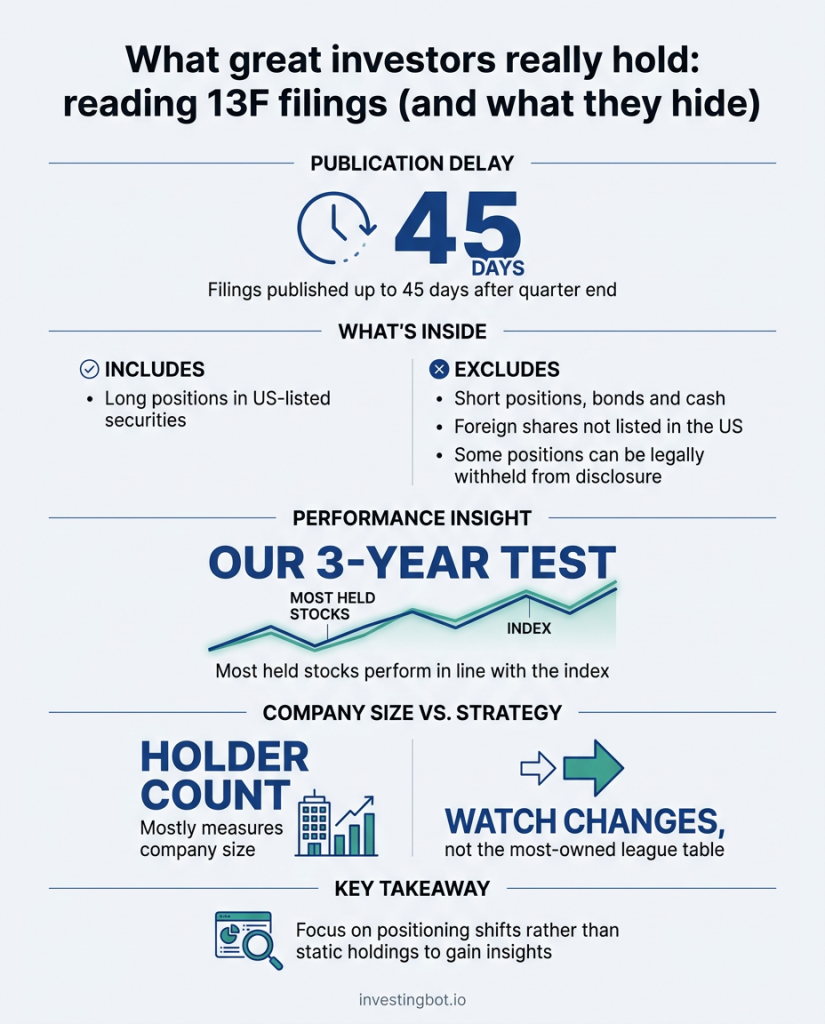
In short
- A 13F shows only long positions in US-listed equities, as of quarter end, published up to 45 days later.
- It contains no shorts, bonds, cash or foreign holdings: it is not the manager’s portfolio, it is the part the law makes visible.
- Some positions can be legitimately withheld, and a filing with no public positions does not mean the fund has sold.
- In our three-year test, the most crowded stocks performed in line with the index: the holder count is largely a measure of size.
- The brilliant result on the least crowded names is survivorship bias, not an opportunity.
- What is worth watching are changes in positioning and the manager’s style, not the league table of most-owned stocks.
Frequently asked questions
How often are 13Fs published?
Four times a year, one per quarter. The filing deadline is 45 days after quarter end, so documents become public in waves and many arrive close to the deadline.
Can I really see a great investor’s portfolio?
You can see the part the law requires them to show: long positions in US-listed securities, as of quarter end. Cash, bonds, short positions and foreign shares do not appear, so what you see may be a fraction of the assets under management.
If a fund exits a stock, does that mean it is a bad investment?
You cannot tell from the filing alone. A position can disappear because of a sale, but also because of client redemptions, a rebalancing, the closing of a hedge, or because the company was acquired. A 13F records the outcome, never the reason.
Is it worth buying the stocks held by the largest number of funds?
In our test across three years of quarters, buying on the date the data becomes public, the most widely held stocks returned about the same as the index. No advantage emerged — and neither did the disadvantage claimed by the opposite “overcrowding” thesis.
Why does a backtest on thinly covered stocks produce such high returns?
Usually because the sample only contains the companies that survived to the present day. Those that failed or were delisted have no complete price series and drop out of the calculation, inflating the result. That is why an extraordinary return on small stocks should always be treated as a suspect, not a discovery.
Do 13Fs apply to European managers too?
The obligation applies to anyone managing US-listed equities above a certain threshold, regardless of where they are based. A European manager with a meaningful position in US shares files; their holdings outside the United States remain invisible in that document.