



![Cover [EN]](https://investingbot.io/wp-content/uploads/2026/07/cover-en-YniSq.png)
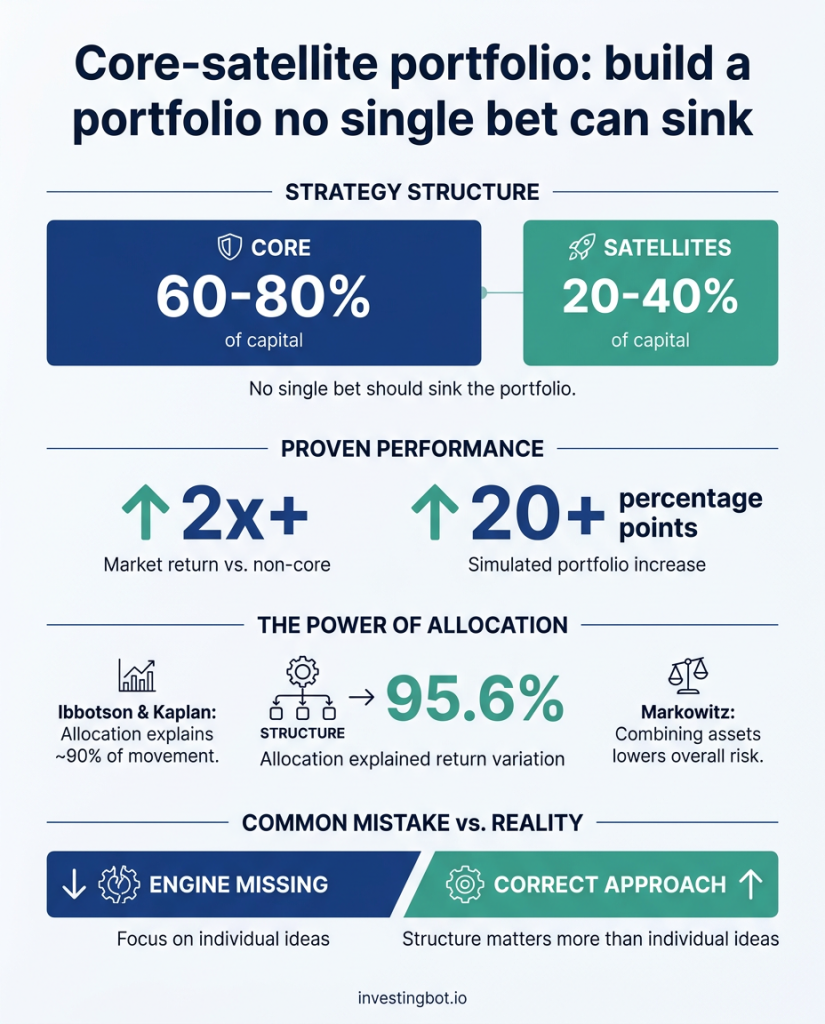
A core-satellite portfolio divides capital into two parts with different roles: a core of 60-80% invested in the broad market through diversified, low-cost instruments, and a ring of satellites (20-40%) where investors can express their own beliefs: a country, a theme, a sector, or a few individual companies. The core captures the market’s return; the satellites attempt to add something extra. The fundamental rule is simple: no single bet should be able to sink the portfolio.
The problem: a portfolio without an engine
The most common mistake isn’t choosing the wrong stocks: it’s building a portfolio without a core. We’ve measured a real-world case that illustrates this better than any theory: an actively managed portfolio, composed solely of regional and thematic bets, with about a quarter of the capital held in cash for years, waiting for the “big dip.” Over a nearly three-year horizon, it returned about 25%, while the global market did more than twice as well.
The surprising thing is that the individual choices were good: several regional bets had worked, some very well. The delay wasn’t in the selection, but in the construction: the engine was missing. When we simulated the exact same portfolio by allocating half the capital to a simple ETF on the market index—and halving everything else proportionally—the result increased by over 20 percentage points, and with lower volatility. Higher returns and fewer fluctuations, without changing a single investment idea: just the structure.
The explanation is simple: over the long term, the bulk of a stock portfolio’s returns comes from the market itself, not from individual choices. Giving up the core means giving up that very part.
This isn’t an impression: it’s one of the most cited findings in the literature. Brinson, Hood and Beebower (Determinants of Portfolio Performance, Financial Analysts Journal, 1986) studied 91 US pension plans and found that allocation policy explained, on average, 95.6% of the variation in total return over time. The figure should be read alongside the qualification added by Ibbotson and Kaplan (Does Asset Allocation Policy Explain 40, 90, or 100 Percent of Performance?, Financial Analysts Journal, 2000): allocation explains roughly 90% of how a portfolio moves over time, but only about 40% of the differences between one portfolio and another. In plain terms: the core decides almost everything about how your portfolio moves, not how far ahead of everyone else’s it ends up.
How a core-satellite portfolio works
The core is the boring and crucial part: broadly diversified, low-cost instruments on the global stock market or major indices, bought and held. Its job is not to beat the market: it’s to be the market. Therefore, it should account for between 60% and 80% of capital, depending on the risk profile.
The principle is as old as modern finance: Markowitz (Portfolio Selection, The Journal of Finance, 1952) showed that combining assets that don’t move in unison lowers overall risk without giving up a proportional share of expected return. The core is that principle applied in the simplest way possible.
Satellites are where it’s legitimate to have opinions: a country that appears to be discounted, a structural theme, a sector where value is seen, a few closely followed companies. Together, they shouldn’t exceed 20-40% of the portfolio, and each should be sized so that a poor outcome—even a halving—shifts the overall result by a few points, rather than compromising it. Some of these tilts have a documented basis — Jegadeesh and Titman (Returns to Buying Winners and Selling Losers, The Journal of Finance, 1993) measured positive returns from buying the strongest stocks of the past 3 to 12 months — but the same study notes that part of that edge fades over the following years: one more reason to keep them in the small part of the portfolio.
Cash plays a structural but small role: a 5-10% buffer for opportunities and unforeseen circumstances. Holding a much larger portion for years, waiting for the perfect moment, is a gamble on market timing, and historical data shows it’s a losing bet in the vast majority of cases.
Sizing rules that save your portfolio
- Single thematic or regional satellite: maximum 10% of the portfolio; for a small country or a very narrow theme, it’s best to limit it to 5%.
- Single stock: 3-5% maximum. Below these thresholds, even a disastrous outcome is still a minor dent.
- Highly speculative instruments (for those who want them): no more than 5% overall, and only with a written exit plan before buying. Without exit discipline, paper profits have a habit of disappearing.
- Number of instruments: 8-12 is enough. Any more adds complexity without adding real diversification.
- The core is not sold to make room for ideas: new ideas are financed by selling (or downsizing) other ideas, or with new contributions.
The errors that this structure prevents
The core-satellite isn’t a magic formula: it’s a safety net against the most costly behavioral errors. Four in particular:
- The “all-bet” portfolio: without a core, the outcome depends entirely on selection skill — and even professionals struggle to sustain it over time.
- Cash parked waiting for the crash: the expected decline often arrives at higher prices than when you started expecting it. The cost of waiting is invisible but accumulates every month.
- Winners left to run with no rules: a satellite that triples in size and reaches 25% of the portfolio is no longer a satellite: it is a concentration risk disguised as success.
- Selling the core on a “bubble feeling”: the structure makes it explicit that the core is untouchable, and that short-term opinions are expressed — on a small scale — through the satellites.
The accumulation plan is the other half of the method
The core doesn’t necessarily have to be built in a day: for those investing income from work, it’s built with periodic contributions, which buy the market with discipline regardless of the current mood. Contributions are also the most efficient way to rebalance: instead of selling what has risen—which in some jurisdictions generates taxable capital gains—new contributions are directed toward the underweighted parts, bringing the portfolio back toward its targets without unnecessary costs.
Tools like our platform’s Portfolio Structure allow you to start from standard models (core-satellite, two funds, lifecycle), view position amounts and sizing rules, and compare risk profiles before moving a euro.
In summary
- The core (60-80%) captures the market’s return: it is the engine of the portfolio, and its absence is the most costly construction mistake.
- The satellites (20-40%) express personal beliefs, with strict limits: 10% per theme, 3-5% per single stock, 5% for speculative instruments.
- In a real-world case we measured, adding a 50% core to the exact same portfolio would have increased returns by more than 20 points while reducing volatility.
- Structural cash is 5-10%: anything more is a market timing bet, historically a losing one.
- The most efficient rebalancing comes from new contributions, not sales.
Frequently Asked Questions
How much should the core weigh?
It depends on the risk profile, but the reference range is 60-80% of the equity portfolio. The more experienced and tolerant the investor, the more they can afford satellites; beginners are wise to stay closer to 80% core—or even 100%: the core-satellite is an option, not a requirement.
Can satellites be single stocks?
Yes, with a 3-5% limit per position. At that size, a company that performs poorly costs your portfolio only a few points; a company that performs very well is still noticeable. It’s a way to follow your convictions without hanging your overall performance on a single stock.
Does a core-satellite portfolio beat the market?
That’s not its purpose, and it’s right to state it clearly: the core, by construction, returns what the market returns, and the satellites can add or subtract value. What the structure guarantees is not outperformance, but risk control: the certainty that no single error—of selection or timing—can compromise the results of years. Sharpe’s arithmetic applies here (The Arithmetic of Active Management, Financial Analysts Journal, 1991): since active managers as a group hold the same market as indexed investors, before costs they earn the same average return — and after costs, less. It isn’t a judgement on anyone’s skill: it’s an accounting identity.
How often should you rebalance?
Two equivalent approaches are available: calendar-based (once or twice a year) or band-based (intervention is made when a portion deviates by more than 5 percentage points from its target weight). In both cases, it’s best to rebalance with new contributions first; sales are used only when contributions aren’t enough, keeping in mind that in some jurisdictions, they generate taxable capital gains.
This article is for informational and educational purposes only and does not constitute personalized financial advice or investment solicitation. Before investing, consult a qualified professional to discuss your situation.