



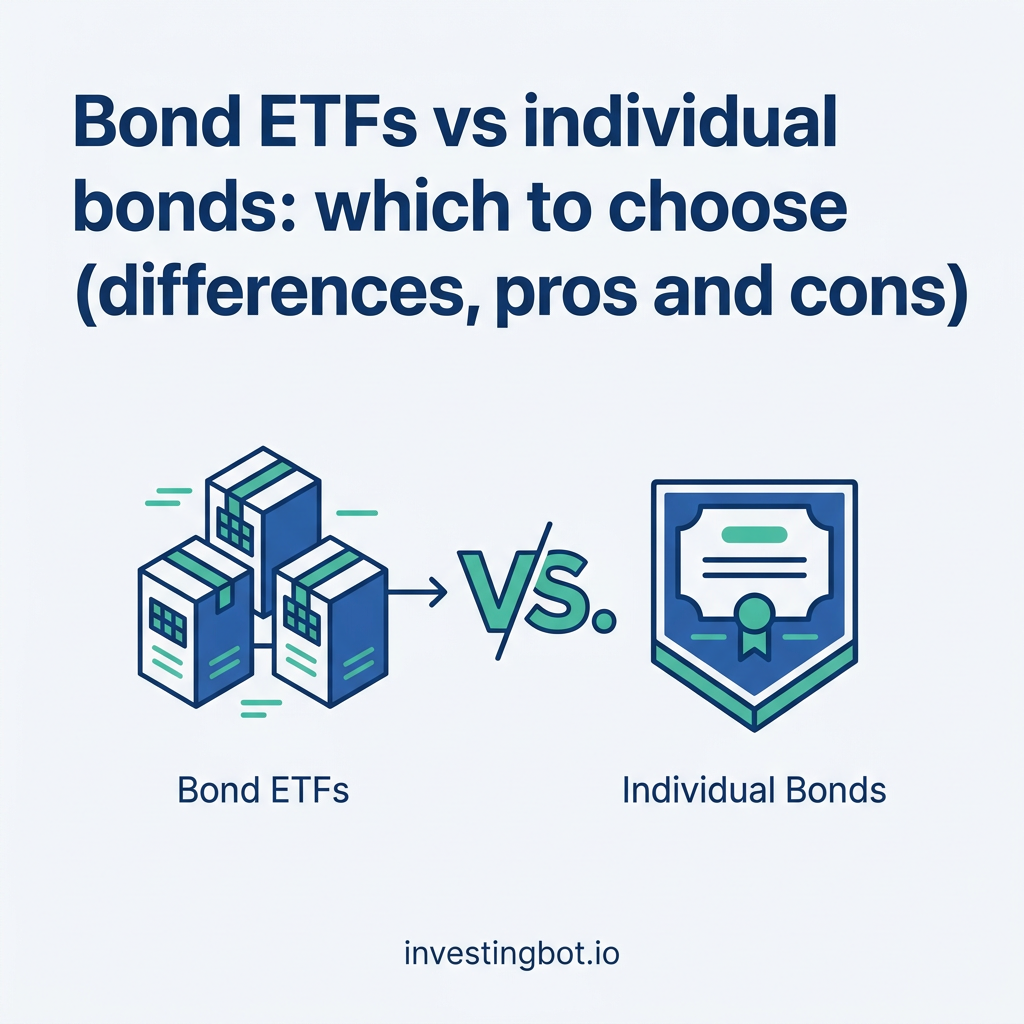
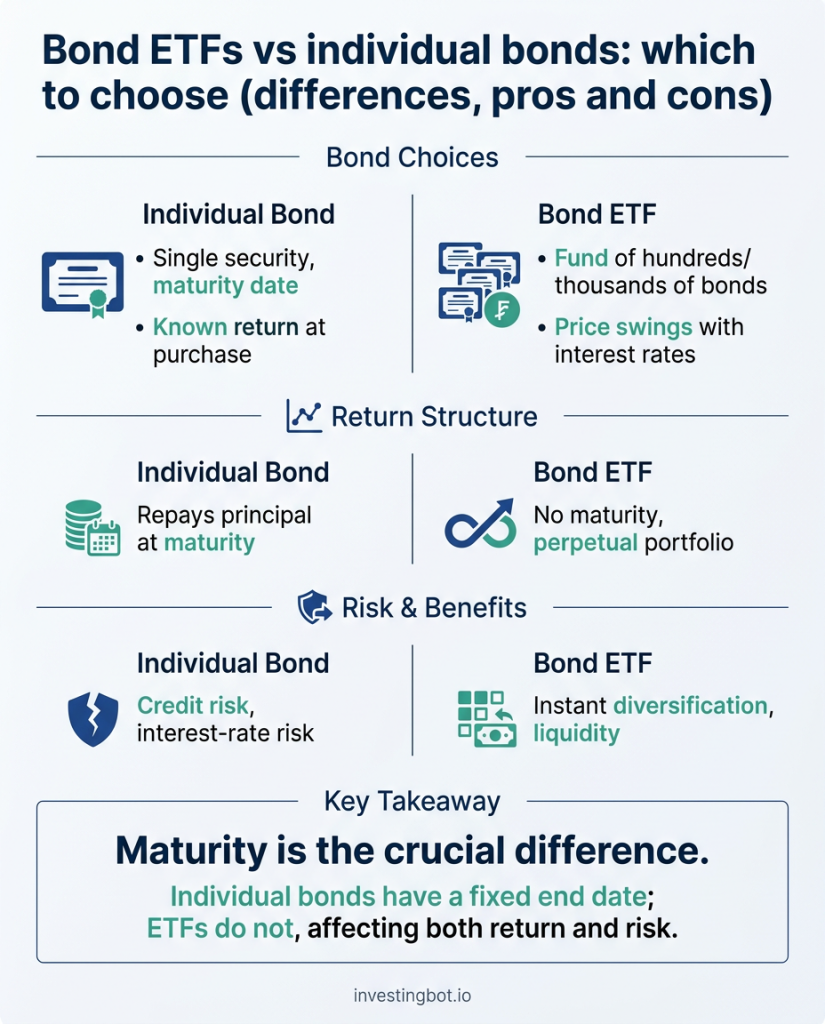
An individual bond is a single security with a maturity date: if you hold it to that day, your principal is repaid and you earn a return known at the moment of purchase (barring an issuer default). A bond ETF is a fund holding hundreds or thousands of bonds that trades like a stock: it gives you instant diversification, liquidity and automatic reinvestment, but it has no maturity — its price keeps swinging with interest rates forever. This is the difference that matters more than any other: an individual bond has an endpoint and a locked-in return if held to maturity; an ETF is a perpetual portfolio that continually rolls its holdings and lives on duration and rates. Every pro and con flows from here.
Put that way it sounds like a nuance, but it radically changes how your money behaves in the tough moments. People who confuse the two often expect from an ETF what only a bond held to maturity can deliver — the return of capital on a set date — and are surprised when the ETF stays underwater for a long time after rates rise. Let us see why, and when each one makes sense.
What an individual bond is
A bond is a loan: you lend money to an issuer (a government, a company, a supranational entity) and in return you receive periodic coupons and, at maturity, the repayment of the face value. At the time of purchase you know the yield to maturity: the annual return you will earn if you hold the bond to the end and the issuer meets its payments. That is its strength: a defined endpoint and a predictable return.
An individual bond does carry two risks not to be underestimated. Credit risk: if the issuer defaults, you can lose much of your capital — and with a single bond that risk is concentrated. And interest-rate risk: if market rates rise, your bond’s price falls (you could sell it at a loss before maturity). The crucial difference is that, if you hold it to maturity, that price loss is only on paper: at the end you are still repaid the face value. As maturity approaches, the price “pulls to par.”
What a bond ETF is
A bond ETF is a listed fund that holds an entire basket of bonds — think of a global aggregate, the government bonds of a region, investment-grade or high-yield credit, emerging markets. You buy and sell it on the exchange like a stock, in real time and even in small amounts. (If you are unclear on what a listed fund is, we covered what UCITS ETFs are.)
The key point, and the source of most misunderstandings, is that a traditional bond ETF has no maturity. As the bonds in the portfolio near their end, the fund replaces them with longer ones: it thus keeps a more or less constant duration profile, but never reaches a day when it “repays capital.” Its value (NAV) rises and falls with rates indefinitely, without the pull to par that saves a single bond held to maturity. In exchange, it gives you instant diversification, liquidity and automatic coupon reinvestment.
The difference that matters most: maturity
Let us boil it down. With an individual bond held to maturity you know two things in advance: when you will get your capital back and how much you will have earned. A rate rise along the way shows you a lower price, but if you wait for the end you still collect the face value. With a bond ETF that day does not exist: duration is a permanent feature, and in a rising-rate scenario the ETF can stay underwater for years, whereas an equivalent bond would simply have matured at par.
This does not make the ETF “worse”: it makes it different. If your goal is to have a precise sum on a precise date (a planned purchase, a future expense), the individual bond’s defined maturity is exactly what you need. If instead you want broad, ongoing fixed-income exposure without managing maturities and reinvestments, the ETF is more convenient.
The exception: defined-maturity ETFs
There is a middle way worth knowing: defined-maturity bond ETFs (often called “target maturity,” or under commercial names such as iBonds/BulletShares). They hold bonds that all mature in the same year, after which the fund returns capital and closes. They behave much more like a single bond or a bond “ladder”: they combine the ETF’s diversification with an endpoint similar to a direct bond. They are useful precisely when you need a defined maturity but do not want to give up diversification.
Diversification and issuer risk
Here the ETF has a clear advantage. With an individual bond your entire capital depends on one issuer: if that one fails, the blow is heavy. An ETF spreads the risk across hundreds of issuers, so a single default becomes almost irrelevant to the total. Building a well-diversified bond portfolio yourself (a “ladder” of many securities, across different issuers and maturities) takes a lot of capital and a lot of work; with an ETF you get it in one click and with a small amount.
The mirror-image downside: with the ETF you give up control. You do not pick the individual bonds, you do not decide which to hold to maturity, you cannot “wait for that bond to pull back to par.” You buy the basket’s average profile, managed under the index’s rules.
Duration and interest-rate risk
Both instruments carry rate risk, but they live it in opposite ways. Duration measures how much the price reacts to a change in rates: a duration of 7 means, as a first approximation, that a +1% move in rates lowers the price by about 7%. For a bond held to maturity that drop is temporary and cancels out at the end; for an ETF duration is permanent, and the price loss has no day on which it automatically recovers. That is why, in a rising-rate environment, understanding duration is decisive: it is your capital’s sensitivity to rates. Our free Bond Analysis tool computes, for each bond, the yield to maturity, the duration and the spread over the risk-free curve of the same currency, so you have the numbers in front of you before deciding.
Costs, liquidity and practicality
The ETF has a recurring cost (the TER), low but continuous: you pay it every year, forever, as long as you hold it. The individual bond has no annual management fee, but it carries wider spreads to buy and sell and can be awkward to trade in small lots — many issues have high minimum sizes and a less liquid secondary market, especially in credit and smaller issuers. The ETF, by contrast, can be bought and sold in real time with minimal spreads even for a few hundred euros, and it reinvests coupons on its own. In practice: the ETF wins on convenience, fractionability and liquidity; the individual bond avoids the recurring cost but demands more capital and more operational effort.
Income: fixed coupon vs variable distribution
An individual bond pays coupons of a known amount on known dates: a predictable stream, useful to anyone planning for certain income. A bond ETF, if it is distributing, pays periodic distributions whose amount varies over time (it depends on the basket’s average coupons, which change as bonds are rolled); if it is accumulating, it reinvests everything internally and pays nothing out. Anyone seeking steady, predictable income will find in the direct bond a certainty that the ETF, by construction, does not offer in the same way.
Taxation: in general terms only
The taxation of coupons, distributions and capital gains varies enormously from country to country and cannot be generalized. In some jurisdictions government bonds (or certain supranational issues) enjoy a reduced rate versus corporate bonds and funds; in others the treatment is uniform. In some legal systems it matters whether the ETF is accumulating or distributing; in others it does not. Foreign bonds may face different withholding taxes depending on the issuer’s country. There is only one practical rule: check the rules of your own jurisdiction (or ask an adviser) before choosing on tax grounds alone — because the same instrument can carry a very different tax burden depending on where you reside.
When each one makes sense
The individual bond makes sense when: you need a precise sum on a precise date (the defined maturity works for you); you want a locked-in return and a predictable coupon stream; you have enough capital to diversify, or you focus on top-quality issuers (where credit risk is minimal). The bond ETF makes sense when: you want instant diversification with little capital; you seek broad exposure to a class (aggregate, high yield, emerging markets, credit) without selecting individual securities; you value simplicity, liquidity and automatic reinvestment; you are accumulating over time. Very often the best answer is not “one or the other” but a mix: the ETF for the diversified backbone, a few direct bonds (or a defined-maturity ETF) for goals with a date.
How our tools help you choose
The choice remains yours, but the numbers must be clear. With Bond Analysis you analyze a single bond by ISIN: yield to maturity, duration, spread over the risk-free curve, price-yield curve and coupon schedule, with the option to verify the data against the official prospectus. On the ETF side, the Screener and an ETF’s AI analysis show you the basket’s TER, duration and credit quality, replication type and — a figure often overlooked — the tracking difference, which tells you how faithfully the ETF actually tracks its index net of costs. In every case the philosophy is the same: we give you the data and the limits, you make the decision.
In summary
- Individual bond: a single security with a maturity. Held to maturity it returns your capital with a known yield (barring default), but it concentrates issuer risk and demands capital and effort.
- Bond ETF: a basket of hundreds of bonds, with no maturity. Diversification, liquidity and automatic reinvestment, but the price swings with rates forever (no pull to par) and you pay a TER every year.
- The decisive difference is maturity: the bond has an endpoint, the ETF is perpetual and dominated by duration.
- Defined-maturity ETFs (target maturity) are the middle way: the ETF’s diversification plus an endpoint similar to a bond.
- Taxation varies by country: always assess it against your own jurisdiction’s rules, never in the abstract.
Frequently asked questions
Can a bond ETF lose money?
Yes. If rates rise, the ETF’s value falls and, having no maturity, there is no day on which capital automatically “pulls back to par”: the loss can persist for a long time. A single bond held to maturity, by contrast, is repaid at face value (barring an issuer default), so the price loss along the way recovers at the end.
What is the duration of a bond or an ETF?
It is the measure of how much the price reacts to a change in rates. As a first approximation, a duration of 7 means that a +1% move in rates lowers the price by about 7% (and vice versa). For a bond held to maturity the effect is temporary; for an ETF it is a permanent feature of the portfolio.
Bond or ETF for a goal on a fixed date?
For a sum you need on a precise date, a direct bond (or a defined-maturity ETF) is more suitable, because it has an endpoint and a known return if held to maturity. A traditional bond ETF, having no maturity, does not guarantee what its value will be on that specific day.
Do bond ETFs pay coupons?
Not fixed coupons like a single bond. A distributing ETF pays periodic distributions of a variable amount; an accumulating ETF reinvests everything internally and pays nothing out. If you seek a predictable income stream, the direct bond offers a regularity the ETF, by design, does not replicate in the same way.
This article is for purely informational and educational purposes and does not constitute personalized financial advice or a recommendation to buy or sell financial instruments. Tax treatment depends on jurisdiction and individual circumstances.