



![Cover [EN] — What are UCITS ETF (and why they are the standard for European investors)](https://investingbot.io/wp-content/uploads/2026/07/cover-en-what-are-ucits-etf-and-why-they-are-the-standard-for-european-investors-g6PFt.png)
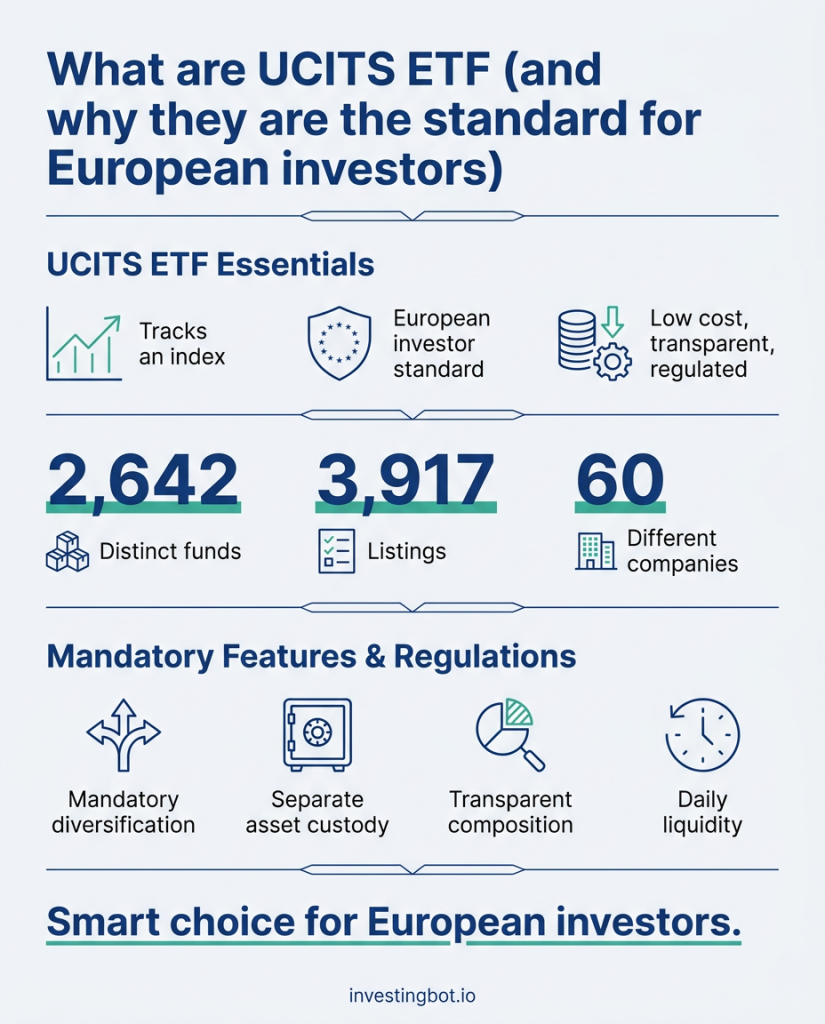
A UCITS ETF is a publicly traded investment fund that tracks an index and complies with European regulations designed to protect investors: mandatory diversification, concentration limits, separate custody of securities from the management company’s assets, and regular publication of its composition. In practice, with a single stock market order, you buy hundreds or thousands of securities, at an annual cost that, in most cases, is measured in tenths of a percentage point. It has become the standard for investors outside the United States because it combines three things that previously did not go together: low cost, transparency, and a uniform regulatory framework.
That’s the definition. The useful part comes later, when we move from the concept to the actual choice—and that’s where ETFs stop being simple. Our ETF search engine currently maps 2,642 distinct UCITS funds, distributed across 3,917 listings on various European stock exchanges, issued by 60 different companies. With those numbers, “buy an ETF” is as incomplete a recommendation as “buy a stock.”
What does “UCITS” really mean?
UCITS is the acronym for a European directive on open-ended funds intended for the public. It’s not a performance quality label—nothing is guaranteed—but a set of structural constraints that apply to all funds bearing that acronym. The four most relevant ones for investors are these.
Diversification imposed by regulation
A UCITS fund cannot concentrate its assets in a few issuers beyond certain thresholds. This means that, even when purchasing a very specific ETF, there is a regulatory limit on how much it can depend on a single stock. This is a silent protection: it acts before the investor even needs to notice.
Separate assets
The fund’s securities are held by a custodian bank and are legally separate from the assets of the company managing the ETF. If the manager goes bankrupt, the fund’s assets do not become part of its bankruptcy. This is why the issuer’s solidity matters less than one might think—though it remains an important consideration for operational continuity and service quality.
Transparency of composition
UCITS ETFs periodically publish their contents. This isn’t a bureaucratic detail: it’s what allows an analysis tool to look inside the fund, aggregate the underlying securities, and determine how much that product is actually exposed to a sector, a geographic area, or a handful of dominant companies. Without this requirement, the analysis would be limited to the fund’s name.
Daily liquidity and continuous pricing
You buy and sell during the trading session, like a stock. With one caveat worth mentioning right away: visible liquidity on the screen isn’t everything. For very small funds, the spread between the buying and selling price can erode a significant portion of the cost advantage, especially for those who trade small and frequent amounts.
What the universe looks like, in numbers
An honest way to explain ETFs is to show how the market is actually composed, rather than describing an idealized version. Here’s a snapshot of our UCITS universe.
- 1,796 equity funds, 709 bond funds, 81 commodity funds, 23 real estate funds, 22 multi-asset funds, and a handful of digital assets. The idea that “ETF equals stocks” is wrong: more than one in four funds is a bond fund.
- Average annual cost of 0.29%, median 0.25%, with the cheapest fund at 0.03%. On a capital of 10,000 currency units, 0.25% is 25 per year—versus the 1.5–2% typical of many actively managed products sold through bank branches.
- 2,021 accumulation funds versus 536 distribution funds: automatic reinvestment of proceeds is now the dominant approach.
- 1,952 physically replicating funds (they actually buy the securities) versus 312 synthetic funds (they use a swap contract with a financial counterparty). These are two different risk profiles, and the difference isn’t visible from the product name.
- 1,773 funds domiciled in Ireland and 700 in Luxembourg: two jurisdictions concentrate almost the entire market, for reasons of infrastructure and treaties on the withholding tax applied to dividends received by the fund.
One last number, the most inconvenient: the five largest issuers hold approximately 85% of total assets. The market is broad in terms of product variety, but much less so in terms of asset distribution.
The real problem is not understanding what they are, it’s choosing them
The 2,642 funds track 1,807 distinct indices. This seems like a huge variety, and in part it is—but the practical effect is different: each popular index is covered by many nearly identical products. On the S&P 500 alone, in our universe, over twenty funds track exactly the same index, with annual costs ranging from 0.03% to 0.20%. We’re talking about the same basket of companies: the difference lies entirely in the product that wraps it.
From here arise the three questions that really matter, and that no definition of “ETF” answers:
- Which index should I track? This is the decision with the greatest impact on the final outcome, and it almost always receives less attention than the choice of fund.
- Which fund replicates it best? The stated cost is only one part of the equation: what matters is the actual difference between the fund’s performance and that of the index, which also depends on the replication method and the product’s size.
- What role does it play in a portfolio? A narrow thematic fund and a very low-cost global fund are different instruments, not alternatives of the same kind.
An ETF isn’t a strategy. It’s a highly efficient container. The strategy is the decision of what to put in it and in what proportions—and that’s where you win or lose, not in choosing between two funds that track the same index by three hundredths of a point.
What an ETF doesn’t solve (and it must be said)
A fund’s internal diversification doesn’t protect against market risk. A global ETF contains thousands of stocks, but when the market declines, it falls too: the broad basket eliminates the risk of a single company ruining the performance, not the risk of everything falling at once. This is a distinction we’ve verified with our own data, and the consequences are less intuitive than they seem—we explained them in the article on how to defend yourself from a bear market.
There are two limitations to the analysis, which we prefer to state. First, for a minority of small or rarely traded funds, some market data is not reliably available, and in those cases the metric is omitted rather than estimated—a missing figure is less damaging than a plausible but incorrect figure. Second, the stated cost does not reflect the quality of the replication; therefore, the actual deviation from the index must be considered separately, and is often the deciding factor between two seemingly identical funds.
Where to start, specifically
A reasonable approach, valid regardless of the amount, is this: first decide on your exposure (how much to stocks, how much to bonds, what geographic coverage), then choose the index that represents it with the smallest possible number of products, and only then compare funds that track that index in terms of cost, size, replication method, and historical deviation from the index. The reverse order—starting with the fund you’ve heard about—is the quickest way to build a portfolio that no one has actually designed.
The tools we use for these three phases are described on the Tools page, while the access conditions are on the Plans page. Further insights on portfolio construction, valuation, and risk can be found on the blog.
In summary
- A UCITS ETF is a listed fund that tracks an index within a European framework of rules: mandatory diversification, assets segregated from the manager, and published composition.
- The UCITS universe includes 2,642 funds from 60 issuers, with an average annual cost of 0.29% and a minimum of 0.03%.
- More than one in four funds is a bond fund: the equation “ETF equals stocks” is wrong.
- The difficulty is not understanding what an ETF is, but choosing between almost identical products: on a single popular index there are over twenty funds with costs that vary by seven times.
- Diversification within the fund does not protect against market declines: it reduces the risk of the individual stock, not that of the whole.
- The declared cost is not enough to judge a fund: what counts is the actual deviation from the replicated index.
Frequently asked questions
What is the difference between an ETF and a traditional mutual fund?
An ETF is bought and sold on the stock exchange during trading hours, with continuous pricing; a traditional mutual fund is subscribed or redeemed at a value calculated once a day. The most significant difference over time, however, is cost: most ETFs track an index at annual costs much lower than those typically associated with active management, and that difference accumulates year after year on the invested capital.
Can an ETF fail and cause me to lose everything?
The assets of a UCITS fund are separate from those of the company that manages it and held by a custodian bank: the insolvency of the issuer does not affect the fund’s assets. The real risk is different, that of the market—if the replicated index loses value, the ETF follows. Synthetic replication funds also have limited exposure to the swap counterparty, which is mitigated by collateral but not eliminated.
Is an accumulating or distributing ETF better?
In the case of accumulation, earnings are automatically reinvested in the fund; in the case of distribution, earnings are periodically paid into the account. The former simplifies long-term accumulation and reduces the number of transactions to manage; the latter generates a cash flow that benefits those who live off the capital. The choice depends on the objective and should also be considered in light of the tax treatment of earnings, which varies from country to country: on this issue, it’s a good idea to check the applicable rules in your jurisdiction.
How many ETFs do you need to have a diversified portfolio?
Less than you might think. A single global equity fund already contains thousands of stocks from dozens of countries. Adding products that largely overlap increases the number of lines in the portfolio without increasing actual diversification: this is the most common mistake among beginners. It makes sense to add a fund when it introduces previously missing exposure—an asset class, an area, a risk profile—not when it tells the same story under a different name.
This content is for informational and educational purposes only and constitutes general advice. It does not take into account the reader’s personal situation, objectives, or risk appetite, and is not a recommendation to buy or sell any financial instrument. The data cited describes the fund universe mapped by our platform and is subject to change. Every investment involves the risk of losing some or all of your capital.