



![Cover [EN] — Dollar-cost averaging: why time in the market beats timing](https://investingbot.io/wp-content/uploads/2026/07/cover-en-dollar-cost-averaging-why-time-in-the-market-beats-timing-KpqlK.png)
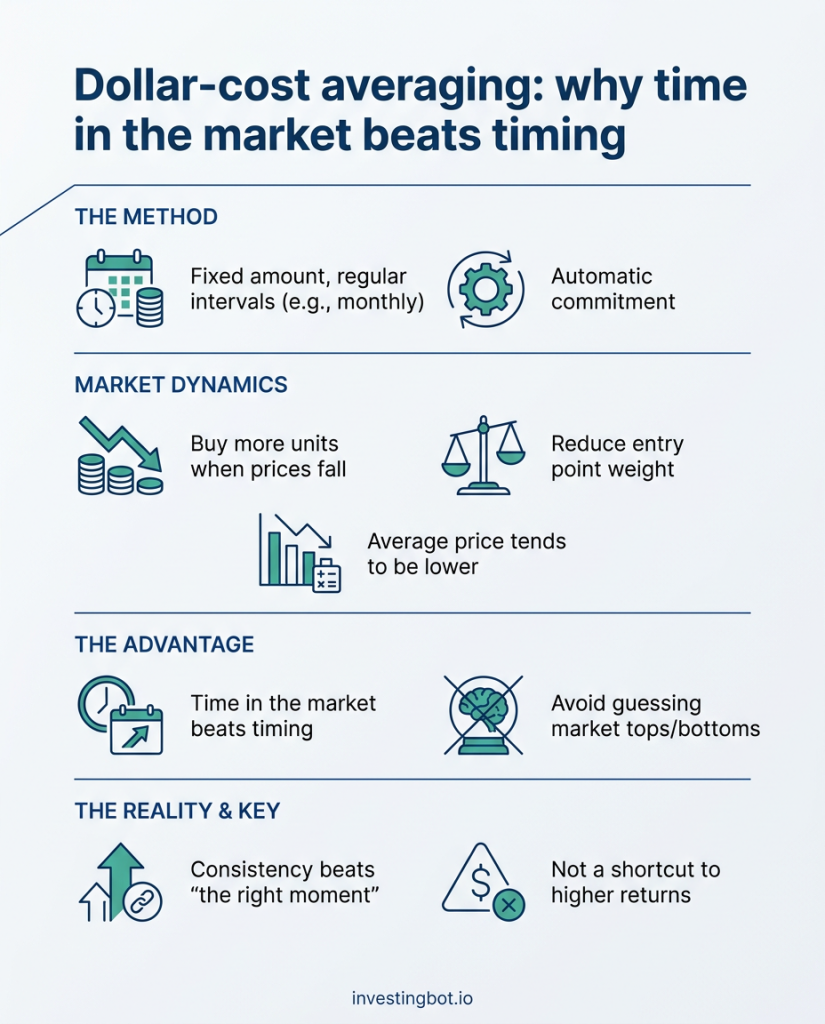
A dollar-cost averaging (DCA) plan means investing a fixed amount at regular intervals — for example every month — instead of trying to find the perfect moment to put it all in at once. The point isn’t really “buying when prices are low”: it’s taking out of your hands the single hardest and most consistently wrong decision, namely guessing tops and bottoms. By investing steadily you buy more units when prices fall and fewer when they rise, you reduce the weight of your entry point, and you stay in the market through every phase. And “staying in” is what matters: historically, time in the market beats trying to predict its moves.
Put that way it sounds obvious. It becomes concrete when you look at what actually happens to people who try the opposite — waiting for “the right moment” with cash in hand. That’s where dollar-cost averaging stops being textbook advice and shows its real value: it isn’t a shortcut to higher returns, it’s a method that neutralises the behavioural mistakes that erode results. Our recurring-investment simulator exists for exactly this: to project a periodic contribution over time and see how much discipline and consistency weigh compared with trying to time the market.
What a dollar-cost averaging plan is, in practice
A DCA plan is an automatic commitment: you choose an amount, a frequency (usually monthly) and one or more instruments — typically low-cost, broadly diversified ETFs — and from then on the contribution runs by itself, regardless of how the markets happen to be doing that day. It isn’t a product: it’s a rule of behaviour you can apply to any instrument.
The technical mechanism is called dollar-cost averaging. Because you always invest the same amount while prices change, the same sum automatically buys more units when the price is low and fewer when it’s high. The average price you end up holding therefore tends to be lower than the simple average of prices over the period. That’s a mathematical effect, not an opinion — but it must be said upfront that it isn’t magic: if the market rises in a straight line for years, a DCA plan enters “late” compared with someone who invested everything at the start. Its strength isn’t maximising returns in every scenario, but making the hardest part manageable: starting, and keeping going.
Why consistency beats “the right moment”
Nobody knows the right moment (not even those who guess it)
The most common instinct is to wait for a dip and buy “at a discount”. The problem is twofold. First: nobody knows in advance when the dip will come, or how deep it will be — often the expected pullback never arrives, and in the meantime the market has already risen. Second, and this is the counter-intuitive part: well-known research on “buying the dip” shows that even with perfect foreknowledge of the lows, waiting in cash loses to investing consistently across the large majority of historical periods. The reason is that, by staying out, you miss the market’s best days — and the best days tend to cluster right next to the worst ones, exactly when instinct says to stay away.
What our own data says about market timing
This isn’t just textbook theory: we checked it on our own backtests. One of our models selects stocks based on a score; to that strategy we added a market-timing filter based on the market regime (buy when the price is above its 200-day moving average, lighten up when it’s below). The result is counter-intuitive but consistent with the literature: the filter worsens the outcome instead of improving it. The monthly hit rate drops to about 60.5% with the timing filter, versus 63.9% by simply staying fully invested. In other words, trying to “get out when the market turns” — even with a mechanical, disciplined rule — subtracted value rather than adding it.
The lesson extends beyond that single model: if a systematic, emotion-free timing filter struggles to beat staying invested, an investor deciding by gut feel, under the pressure of the news, starts far further behind. A DCA plan is the practical way to encode this lesson: it invests for you, every month, without asking whether it’s “the right moment”.
The time effect: what actually makes the difference
The real engine of a long-term plan isn’t market timing, nor even picking the one perfect instrument: it’s time, through compound growth. An illustrative example helps to see it — with a blunt warning before the numbers even appear: the figures below are a hypothesis, not a forecast and not a promise. Real returns vary, they can be negative for years, and the value of an investment can fall.
Imagine contributing 300 a month for 25 years. The capital that leaves your pocket is 90,000 in total. At a hypothetical average return of 5% a year, those contributions would grow to roughly 179,000: almost half of the final value is compound growth, not money you paid in. But change the assumption and everything changes: at 3% a year the result would drop to about 134,000, and in a genuinely unlucky 25-year stretch it could stay close to the capital contributed. None of these numbers is guaranteed — they serve to show one thing: the variable the investor controls most isn’t the return (which depends on the market) but the duration and consistency of the contributions. And that is exactly what a DCA plan protects.
DCA or investing it all at once?
A frequent and legitimate question: if I already have a lump sum, should I invest it all now or gradually with a DCA plan? The honest answer, on historical data, is less intuitive than it seems: because markets rise more often than they fall, investing the lump sum all at once beats gradual entry in most periods, simply because it puts the capital to work sooner. Gradual DCA does have a different, real advantage, though: it reduces regret in the worst case. If you invest everything today and the market crashes tomorrow, the psychological damage can push you to sell at the wrong moment. Spreading the entry over several months doesn’t maximise expected return, but it makes the experience more bearable — and an investor who stays invested beats a theoretically optimal one who bails out halfway. The choice, then, depends less on the maths and more on how well you know your real risk tolerance.
The limits of dollar-cost averaging (it must be said)
An honest method is recognised by how it describes its own flaws. Three must be made clear.
- It doesn’t remove market risk. DCA reduces the weight of your entry point, not the possibility that the whole market falls. A broad basket stops a single company from ruining the result, but when everything falls together, your plan falls too. It’s the same distinction we covered in the article on how to defend yourself in a bear market.
- In a market that rises straight away, it “lags behind”. Compared with someone who invested everything at the start of a long rally, DCA accumulates more slowly. Its value emerges in uncertainty and discipline, not in maximising every bullish scenario.
- The hard part is continuing when it hurts. The moment a DCA plan is worth the most — when prices are low and you’re buying many units cheaply — is also the one when instinct screams to stop. Automating the contribution is precisely what protects the rule from yourself.
How to set up a plan, concretely
Turning the principle into practice takes four decisions, in this order:
- The sustainable amount. Not the figure that makes you feel ambitious, but the one you can contribute every month even in a difficult year without having to stop. An interrupted plan loses much of its point.
- The instrument. Usually one or a few broadly diversified, low-cost ETFs: the annual cost they subtract matters far more than the choice of “moment”. The difference between near-identical instruments on the same index is measured in fractions of a percentage point, and over twenty years it adds up.
- The frequency and automation. Monthly is the standard. Automation isn’t a detail: it’s what makes discipline independent of your mood in a given month.
- Periodic — not daily — review. A plan is checked once or twice a year to make sure the proportions haven’t drifted too far, not every day to react to the news.
The tools we use to simulate a plan, estimate the effect of time and assess ETF costs are described on the tools page; the access terms are on the plans page, and further material on portfolio, risk and valuation is on the blog.
This very evidence gave rise to a free platform tool, the DCA Traffic Light: not a market-timer, but a discipline regulator that helps you not to stop — or drain — the plan in moments of fear. Inside it we embedded an honest backtest over 155 years of the S&P 500 (since 1871, Shiller data): comparing, at equal capital invested, steady accumulation against strategies that trim purchases when the market looks expensive, the result is clear and uncomfortable. Across every rolling 20- and 30-year window, trying to time the market systematically loses to steady dollar-cost averaging. That is why the light stays green: keep contributing, don’t stop on a feeling. It is exactly the lesson of this article, measured over a century and a half of history.
In summary
- A dollar-cost averaging (DCA) plan means investing a fixed amount at regular intervals: it shifts the focus from “when to enter” to “staying invested over time”.
- Dollar-cost averaging buys more units when prices fall and fewer when they rise, reducing the weight of your entry point — but it isn’t a shortcut to higher returns.
- Market timing is nearly impossible: even knowing the lows in advance, waiting in cash loses in most cases. In our backtests, a timing filter based on the market regime worsens the outcome (60.5% versus 63.9% by staying fully invested).
- The engine of the long run is time: in an illustrative example (not a promise), 90,000 contributed over 25 years is worth about 179,000 at a hypothetical 5% a year, but only ~134,000 at 3% — consistency matters more than prediction.
- DCA doesn’t remove market risk and “lags” in straight-line rallies: its value is the discipline that neutralises behavioural mistakes.
Frequently asked questions
Does a DCA plan guarantee I won’t lose money?
No. No method removes the risk that the market falls. DCA reduces the risk tied to the moment you enter and makes discipline easier to keep, but the value of a portfolio can still decline, even for a long time. Anyone promising otherwise is selling an illusion.
How often should I contribute, monthly or quarterly?
Monthly is the standard and has two practical advantages: smaller, more sustainable amounts, and a purchase cost averaged over more moments. The return difference between monthly and quarterly is typically marginal; what matters far more is that the contribution is automatic and never interrupted.
I have a lump sum: should I invest it all at once or with a DCA plan?
On historical data, investing the lump sum at once beats gradual entry in most periods, because it puts the capital to work sooner. Gradual DCA is worth it, though, if the risk of panic-selling after an early crash is real for you: it reduces regret in the worst case at the cost of a little expected return.
If the market drops after I start, should I stop the plan?
That’s exactly the moment when stopping does the most damage. When prices fall, the same amount buys more units: it’s the phase in which DCA works best. The difficulty is emotional, not mathematical — which is why automating the contribution is the most effective protection against yourself.
This content is for informational and educational purposes only and is not personalised investment advice. The projections are illustrative hypotheses, not forecasts: past returns do not guarantee future ones and the value of an investment can decrease.