



![Cover [EN]](https://investingbot.io/wp-content/uploads/2026/07/cover-en-tgBth.png)
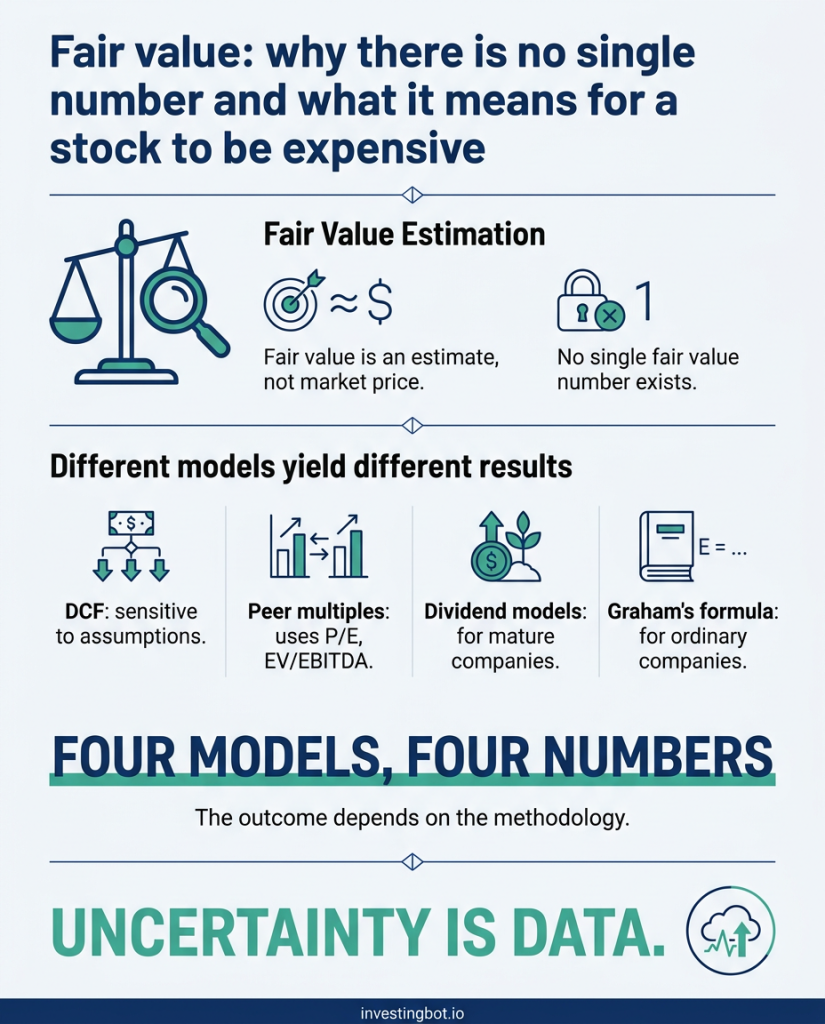
Fair value is an estimate of what a company is worth based on its fundamentals — earnings, cash flow, growth, risk — and it is a different thing from the price you see quoted on the market. The uncomfortable truth is that there is no single number: different models give different answers, so an honest fair value is always a range that comes with a degree of uncertainty. A stock is “expensive” when its price sits well above that range; it is “at a discount” when it sits below, but only with enough margin to protect you from your own estimation errors.
Fair value and price are not the same thing
Price is what the market asks today: it changes every second, driven by news, emotion and flows. Fair value is an estimate of what a company should be worth if the market were perfectly rational. The two numbers rarely coincide, and it is precisely that gap that matters to an investor: when price is far below fair value there may be an opportunity; when it is far above, the stock already discounts a lot of good news.
The subtle part is that fair value cannot be “observed” the way price can — it is estimated. And every estimate comes from a model, and every model from a set of assumptions. Change one assumption and the number changes.
Why there is no single number: the valuation models
Different families of models exist, each looking at the company from a different angle:
- Discounted cash flow (DCF): it projects the cash the company will generate in future years and brings it back to today with a discount rate. It is the most theoretically correct, but also the most sensitive to assumptions: a couple of extra points on growth or on the discount rate can move the result by tens of percentage points.
- Peer multiples: it compares the company with its peers using ratios such as price/earnings (P/E) or enterprise value/EBITDA. Simple and anchored to the real market, but if the whole sector is overvalued the multiple “inherits” that.
- Dividend models (DDM): they value the stock as a stream of growing dividends. Useful for mature companies that pay stable cash, poorly suited to companies that pay none.
- Graham’s formula (intrinsic value): the classic value-investing approach, based on earnings and moderate growth. Robust for “ordinary” companies, misleading where accounting earnings are distorted.
The practical consequence is simple: hand the same company to four different models and you get four different numbers. That is not a flaw to hide — it is information. The median of these models gives a reasonable central estimate, while their dispersion tells you how much you can trust it.
Uncertainty is data, not a nuisance
When the models agree, fair value is a narrow range: uncertainty is low and the central estimate is reliable. When the models fight — say a DCF that says “expensive” and multiples that say “cheap” — the range widens and uncertainty is high. In that case a single point number is false precision: it only makes sense to reason about the range.
It is the same principle as volatility and the projection cone: an honest range is worth more than a precise “target”, because it communicates both the estimate and the margin of error. A fair value quoted to three decimals suggests a certainty we do not have; a fair value quoted as “between X and Y, with medium uncertainty” is far more useful for deciding.
Growth or value: why you need different models
Not all companies are valued the same way, and this is where many people go wrong. A fast-growing company, with small earnings today because it reinvests everything, looks “wildly expensive” on a P/E multiple — but that multiple knows nothing about future growth. For these companies a multi-stage DCF and the PEG (P/E relative to growth) matter more, while Graham’s formula and simple multiples are misleading.
At the opposite end, a real-estate company (REIT) has an accounting profit depressed by depreciation: valuing it on P/E makes it look expensive when it may not be. Here you need dedicated cash metrics (such as operating cash flows, FFO) rather than earnings per share. Banks and insurers likewise require their own models.
The lesson: before you ask “is this stock expensive?”, you need to know what kind of company you are valuing. Applying the wrong model produces a wrong number wearing the mask of precision.
The margin of safety: fair value is not enough
Even the best estimate remains an estimate. That is why Benjamin Graham, the father of value investing, taught not to buy at fair value but at a discount to it: the so-called margin of safety. If you judge a company to be worth about 100 and the market offers it at 70, that 30% discount is your cushion against the chance that your estimate was too optimistic. The higher the uncertainty, the wider the margin you should demand.
It is the flip side of the most common mistake: buying a stock just because it has gone up, with no reference price. Without a fair value you have no yardstick to tell whether you are paying for a bargain or for an illusion.
How we handle it (and the limits we state)
Our fair-value tool does not bet on a single model: it computes several models in parallel, shows the median and the full range, and assigns an uncertainty level (low, medium or high). It automatically adapts the models to the company’s profile — growth, value, real estate, financial — and shows the margin of safety versus price.
We state the limit openly, because it is part of the honesty of the method: when the models diverge too much (high uncertainty) we do not show a single number as if it were truth; we show the range and invite you to cross-check it with the company’s financial health and positioning. A fair value is not a prediction of tomorrow’s price: it is a compass to tell whether today you are paying too little, the right amount, or too much. It exists to remove the anchor to your purchase price and to let you decide with a yardstick, not a feeling.
Key takeaways
- Fair value is the value estimated from fundamentals, not the market price.
- There is no single number: different models (DCF, multiples, dividends, Graham) give different estimates → the honest answer is a range.
- The width of the range is information: a narrow range means high reliability; a wide range means high uncertainty — use the range, not the point number.
- Growth, value, real-estate and financial companies need different models: using the wrong one produces misleading numbers.
- Fair value alone is not enough: you need a margin of safety — buying at a discount that widens as uncertainty rises.
- A stock is “expensive” when its price clearly exceeds the fair-value range, taking the business profile into account.
Frequently asked questions
Are fair value and target price the same thing?
No. The target price is usually the analyst consensus price objective; fair value is a model-based estimate of intrinsic value. They can differ substantially: when they do, the divergence itself is a signal to investigate, not a detail to ignore.
If fair value is above the price, should I buy?
Not automatically. A discount to fair value is a necessary but not sufficient condition: you must consider the margin of safety, the level of uncertainty in the estimate, and the quality of the company. A “huge” discount with high uncertainty is often a mirage, not a bargain.
Why do two models give such different numbers?
Because they start from different assumptions: future growth rate, discount rate, sector multiples, time horizon. Small differences in the inputs amplify in the result. That is why the dispersion between models is as informative as their median.
Does fair value change over time?
Yes. It changes when the fundamentals change (earnings, growth, debt) and when market assumptions change (for example interest rates, which shift the value of growth companies). It should be updated, not treated as a fixed label.
Does a high fair value guarantee a good investment?
No. A great company can be a poor investment if the price has already discounted it. This is the mistake of confusing the quality of the company with the attractiveness of the stock: they are two different lenses and both must be looked at.
This content is for informational and educational purposes only and does not constitute personalized financial advice or an invitation to buy or sell financial instruments. Valuations are estimates subject to uncertainty; always verify independently and, if needed, consult an advisor.