



![Cover [EN]](https://investingbot.io/wp-content/uploads/2026/07/cover-en-7TZrD.png)
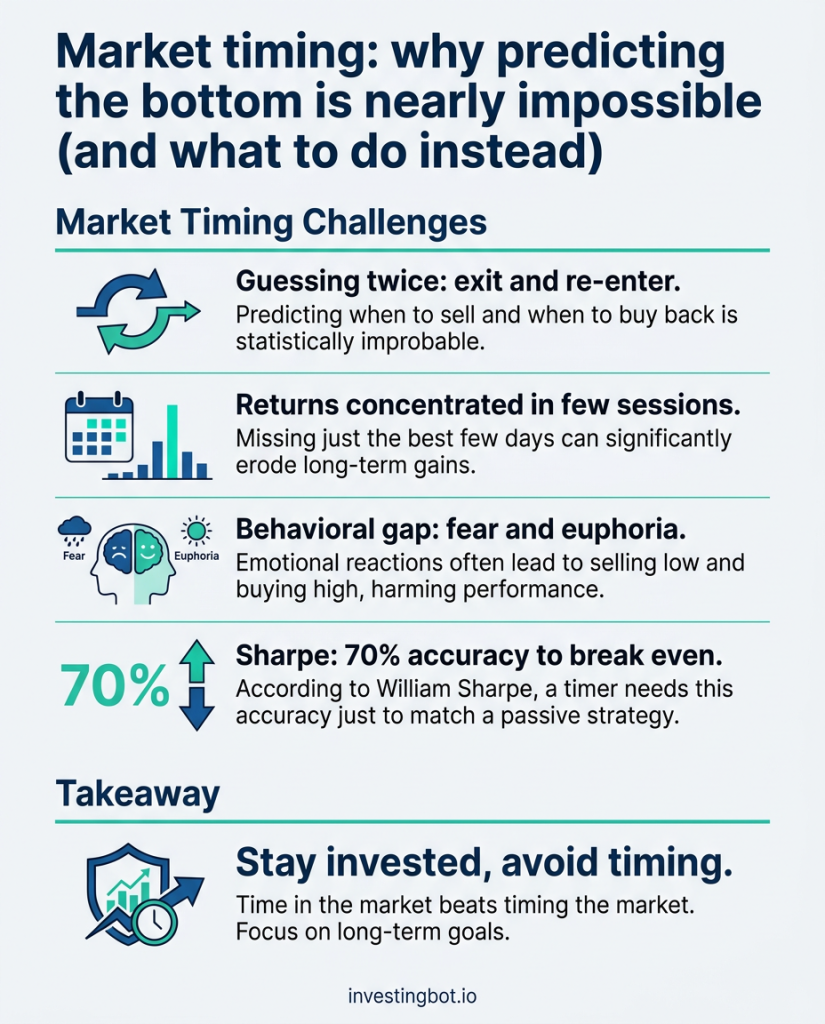
Market timing—trying to enter on the lows and exit on the highs—is nearly impossible to achieve consistently, because it forces you to guess twice (when to exit and when to re-enter) and because a huge portion of long-term returns are concentrated in a few trading sessions that no one can predict. The vast majority of evidence—academic and from our own backtesting—indicates that staying invested with a disciplined approach beats trying to predict market turns. In this article, we explain why, show what our data tells us (including the inconvenient limitations of our tools), and what to do instead of timing.
Why market timing is so difficult
The first problem is that you have to be right twice over. Exiting before a dip is only half the battle: you also have to get back in at the right time, usually when the news is the worst and fear is at its highest. Those who “wait for the dip” often stay liquid as the market rises, and end up buying back higher than where they sold.
The second problem is the concentration of returns. Over long time horizons, most of the gains come in a very small number of trading sessions—and those best sessions tend to occur precisely during the most turbulent periods, close to the lows. Those who stay out of the market to “wait out the storm” risk missing out on the very rebounds that make the difference. Staying invested ensures you’ll be there for those days; trying to skip them exposes you to the opposite risk.
The third problem is behavioral. Timing amplifies human error: people sell out of fear after a crash (freezing the loss) and buy out of euphoria after a rally (paying dearly). This is the so-called behavior gap: the gap between a fund’s performance and the actual performance of its investors, who enter and exit at the wrong times.
The Sharpe Threshold: How Good Should You Be?
As early as 1975, Nobel Prize winner William F. Sharpe, in “Likely Gains from Market Timing” (Financial Analysts Journal), quantified the problem: a market timer must guess the market direction a very high percentage of the time—on the order of 70% of the time —just to break even with a simple buy-and-hold strategy, once the years of error are accounted for. Mistiming the exits has an asymmetric cost: just a few wrong moves can cancel out the benefits of many right moves. It’s a barrier that very few overcome consistently, and fortunately never for long.
The underlying reason was formalized by Eugene Fama with the efficient markets hypothesis (1970): prices already incorporate the available public information, therefore systematically predicting the next turning point starting from what is already known to everyone is structurally difficult.
What our data says (including the inconvenient limitations)
We don’t ask you to take our word for it: we measured it on our instruments, and some results are uncomfortable even for us.
- A regime filter makes results worse, not better. Testing our stock scoring model, we tried adding a classic “trend filter” (staying invested only when the price is above the 200-day moving average). The result: the success rate drops (about 60% versus the 64% achieved by staying invested all the time). Trying to time the market’s regime—even with a reasonable signal—detracts value rather than adds it, because the moving average is slow and makes you exit after the dip and re-enter after the rebound.
- Holding cash “for the downside” is a systematic loser. Using Robert Shiller‘s historical data of the US stock market (data dating back to 1871, over 150 years), we compared steady accumulation with a strategy that holds a cash reserve to invest on downsides (“buy when the market goes down”). Across all 20- and 30-year time horizons, steady accumulation beat the reserve strategy. Even a valuation-based filter (buying less when the market is expensive) only wins in a minority of cases. Time spent out of the market costs more than “timely” entries.
- Even stock selection can’t time crashes. Our selection advantage works well when the market rises (it beats the index in about 71% of bull months) but reverses when the market falls (it falls below 40% in bear months). In other words: no signal, however good on the upside, is a time machine that protects you from a downside.
The lesson is consistent and honest: tools are used to understand a company, a risk, or a valuation, not to guess the right day to enter or exit the market as a whole.
What to do instead of market timing
- Time in the market, not market timing. Staying invested consistently captures the best days without having to predict them. It’s boring, and that’s exactly the point.
- Accumulate on a scheduled basis (dollar-cost averaging). Investing a fixed amount at regular intervals takes the emotional decision out of your hands: you automatically buy more shares when prices are low and fewer when they are high, without having to guess.
- Rules instead of gut instincts. A written plan—how much to invest, how to diversify, when to rebalance—neutralizes the urge to sell in panic or buy in euphoria. Discipline, not foresight, is the true advantage of the long-term investor.
- Use valuation to calibrate expectations, not to time the market. Knowing that a market or security is expensive helps moderate future return expectations and size positions, not decide the exact day to exit.
This is the philosophy behind our DCA Traffic Light: a free tool that, instead of telling you to “exit now,” deliberately stays green —continuing your accumulation plan—and incorporates as evidence the honest backtesting of 150+ years of data that debunks market timing. It’s not a signal generator: it’s a discipline regulator.
In summary
- Market timing forces you to guess twice and not miss the few sessions that make up most of your returns: almost impossible with consistency.
- Sharpe (1975) estimated that you need to guess right about 70% of the time just to break even on the buy-and-hold.
- Our backtests confirm this: a regime filter worsens results, holding cash for declines loses on all long time frames, and even stock selection reverses in crashes.
- The answer is not to predict, but to stay invested methodically: planned accumulation, written rules, discipline.
Frequently Asked Questions
Shouldn’t we at least get out before the biggest crashes?
In theory, yes; in practice, almost no one consistently succeeds: you have to get both your exit and re-entry right, and the best rebounds come precisely when fear is at its highest. Data shows that the cost of mistakes (and time out of the market) generally outweighs the benefit of a few lucky exits.
Isn’t dollar-cost averaging a form of market timing?
No, it’s the opposite: instead of choosing when to enter, you invest at fixed intervals regardless of the market level. You eliminate discretionary decision-making—and therefore emotional bias—by automatically distributing your purchases over time.
What if the market is clearly in a bubble?
A high valuation tells you something about expected long-term returns, not the day the bubble bursts: markets can remain expensive—and become more expensive—much longer than seems sustainable. Valuation is useful for calibrating expectations and position sizing, not for timing exits.
Even professionals can’t time the market?
Long-term evidence shows that the majority of active managers don’t consistently beat a simple index, and that timing is one of the most difficult tasks of all. This is one reason why tools should help you understand risk and valuation, not promise short-term forecasts.
This content is for informational and educational purposes only and does not constitute personalized financial advice or investment recommendations. Past performance is no guarantee of future results.