

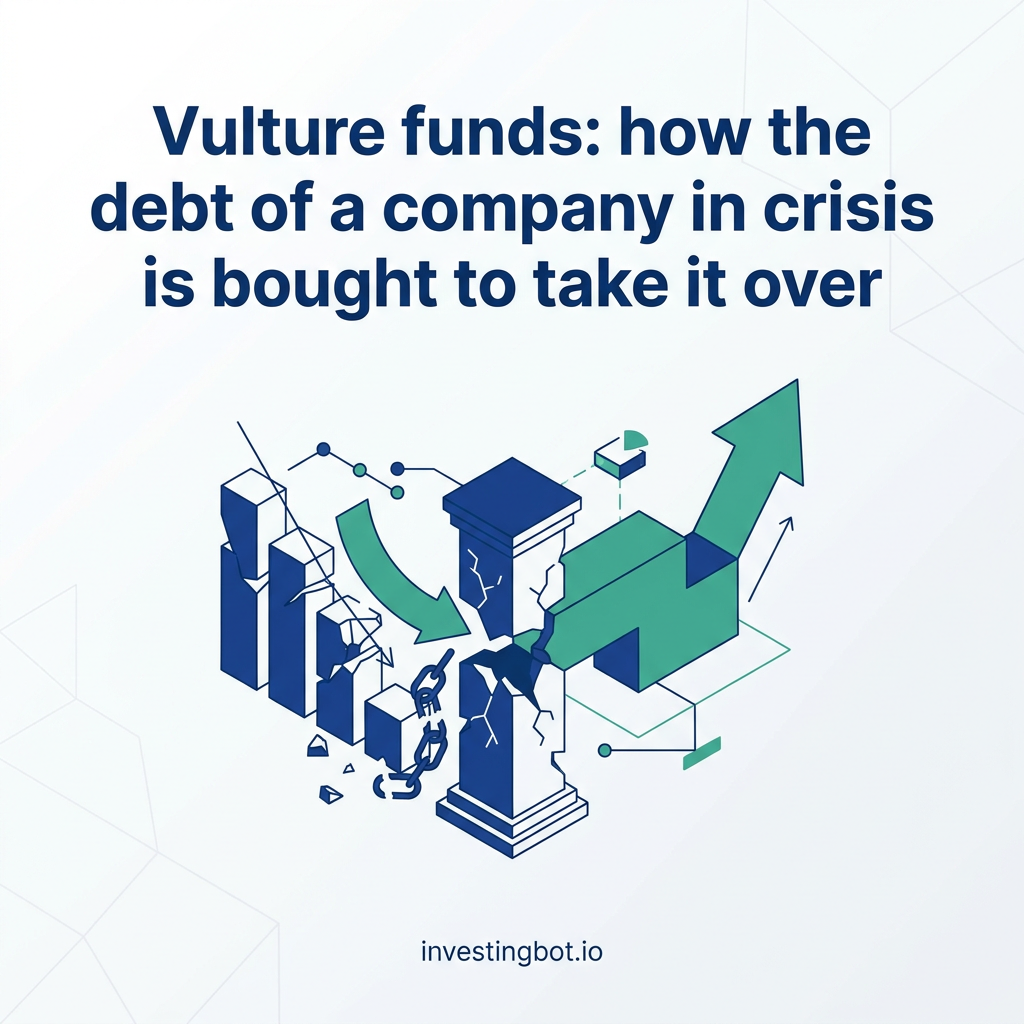
Vulture funds buy, at a deep discount, the debts of companies (or countries) in trouble. Some aim to be repaid in full; others aim to convert that debt into shares and take over the company: the strategy known as loan-to-own. It is almost always legal, and the bill usually goes to the old shareholders, largely small investors who do not know how a restructuring works.
What vulture funds are, in a nutshell
When a company risks not paying its debts, its bonds and loans trade on the market far below face value: 40, 30, sometimes 10 cents on the dollar. Whoever buys at those prices is betting on what they will recover in the end. The name «vulture» comes from the idea of feeding on those in trouble; practitioners prefer «distressed investing».
There are two strategies, and they often blend:
- recovering the claim: buying at 30 and getting 60 or 100, even by suing the debtor;
- taking control: buying enough debt to decide how the company will be restructured, and coming out as its main shareholder.
How loan-to-own works
In the United States the scheme almost always runs through Chapter 11, the reorganisation procedure of the US bankruptcy code. Many other countries have similar procedures, and in Europe Directive 2019/1023 introduced preventive restructuring frameworks. The steps are these:
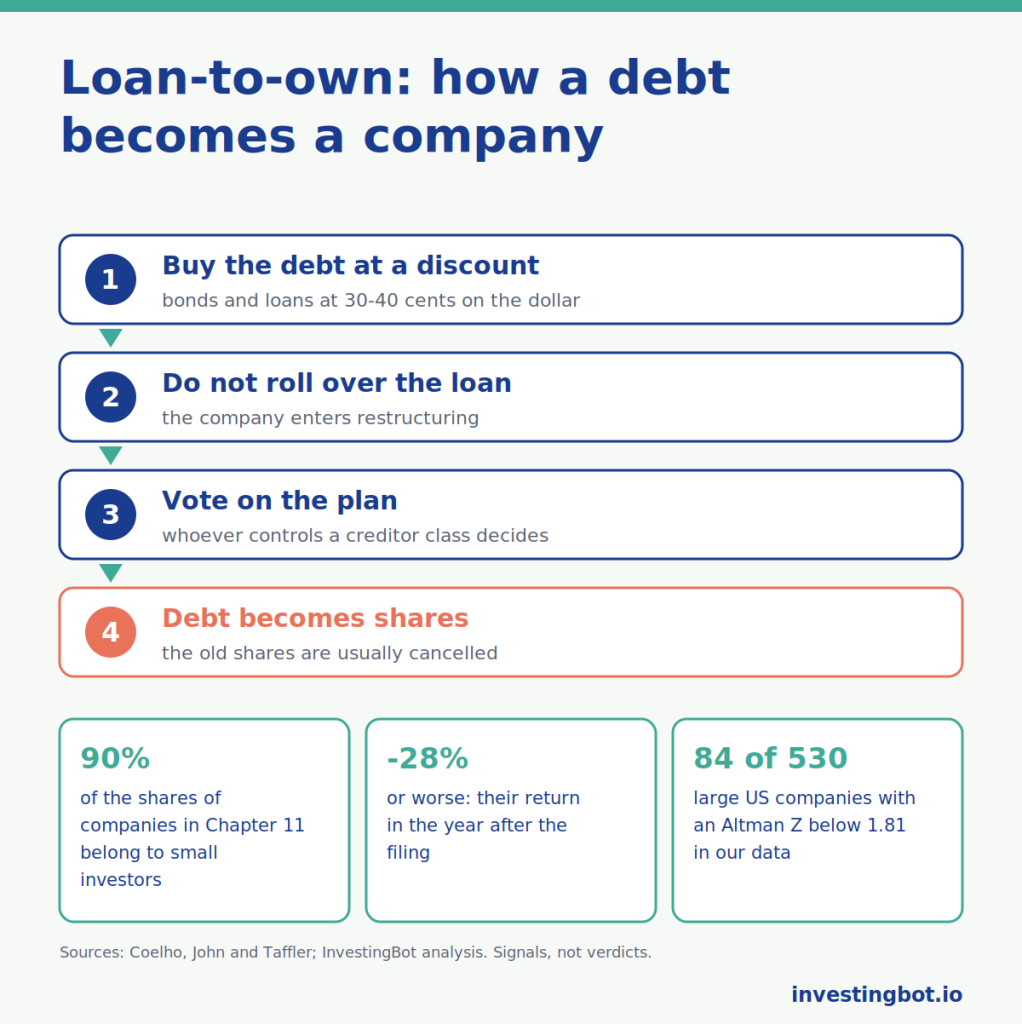
- buy the right debt: not all of it, but the class of creditors that will receive the new shares in the restructuring, the one sitting on the line between those paid in full and those who lose (specialists call it the «fulcrum security»);
- do not roll over and do not give time: whoever holds a maturing loan is not obliged to refinance it. If the company finds no other lenders, it ends up in the procedure;
- vote on the plan: in these procedures creditors vote by class, and whoever holds a large share of a class can block a plan or push another one through;
- debt becomes equity: the claim is converted into shares of the new company. The old shares are often cancelled.
The old shares are wiped out because of a rule, absolute priority: in a restructuring creditors must be paid before shareholders, and until creditors recover everything, shareholders are normally left with nothing.
A documented case: Kmart, 2002-2003
Kmart, one of the large American discount store chains, filed for Chapter 11 on 22 January 2002. During the procedure Edward Lampert’s fund ESL Investments bought a large part of its debt at a discount, for less than a billion dollars according to reports at the time. Under the reorganisation plan the claims were converted into shares: ESL emerged as the largest shareholder, with about 49%, and Lampert became chairman when the company left the procedure on 6 May 2003.
The old shareholders fared differently. The plan provided for the old shares to be cancelled on the exit date; the documents filed with the US securities regulator, the SEC, state that the old shareholders would receive nothing, except a possible share of up to 2.5% of the recoveries of a trust set up for creditors. In 2005 the new Kmart bought Sears.
Sovereign vultures: the Argentina case
The same scheme applies to government debt. After its 2001 default Argentina restructured its bonds in 2005 and 2010, but some funds refused the exchange and sued in New York. The best known was NML Capital, part of the Elliott Management group. US courts ruled that Argentina could not pay those who had accepted the restructuring without also paying those who had refused it; on 16 June 2014 the US Supreme Court rejected Argentina’s appeal.
In February 2016 the Argentine government settled with four of these funds for about 4.65 billion dollars, equal to 75% of what the courts had awarded them in principal and interest. It is the case that made the phrase «vulture funds» famous outside the industry.
What the research says: not just predators
Academic research paints a less simple picture than the name. Edith Hotchkiss (Boston College) and Robert Mooradian (Northeastern University), in «Vulture investors and the market for control of distressed firms» (Journal of Financial Economics, 1997), studied 288 companies that defaulted on public debt. When a vulture investor becomes chief executive or chairman, or takes control, operating performance after the restructuring improves more; and when its purchases are announced, the company’s shares and bonds rise. Their conclusion: these investors create value by disciplining the managers of distressed companies.
Wei Jiang (then at Columbia Business School), Kai Li (University of British Columbia) and Wei Wang (Queen’s University), in «Hedge Funds and Chapter 11» (Journal of Finance, 2012), show on 474 Chapter 11 cases between 1996 and 2007 that when hedge funds enter the debt, the chances of a change of chief executive and of emerging from the procedure rise, and junior creditors recover more. Vultures, in other words, speed up restructurings: the question is who pays for it.
Where the line runs
Much of what these funds do is legal, even when it is ruthless. The line runs roughly here:
- legal: buying debt at a discount, not rolling over a maturing loan, voting against a plan, suing to be paid;
- grey area: buying debt with the stated aim of taking over the company at a rock-bottom price, using the weight of a creditor class to exclude other creditors from deals, pushing a company into the procedure instead of refinancing it. Courts decide on these practices case by case;
- illegal: whoever sits on creditor committees receives confidential information about the company, and using it to buy or sell securities is insider dealing.
What the small shareholder risks
In companies that stay listed during a restructuring procedure, the shares are largely in the hands of small investors. Luís Coelho (Universidade do Algarve), Kose John (New York University) and Richard Taffler (Warwick Business School), in the paper «Who trades the stock of bankrupt firms?», found that small investors own on average 90% of them and that in the year after the Chapter 11 filing those stocks returned -28% or worse. Their explanation: buyers are looking for a lottery ticket, and the professionals who could correct the price stay away.
In 2020 Hertz, in Chapter 11, tried to sell up to 500 million dollars of new shares to exactly these buyers, warning in its documents that the shares could end up worthless. After comments from the SEC the offering was suspended. In that case, for once, shareholders eventually recovered a lot: an exception that makes the lottery even more tempting.
The signals you can see in advance
Vultures arrive when the signs of trouble are already in the accounts. Two are the easiest to read:
- the Altman Z-Score, a score proposed by Edward Altman (New York University) in 1968: below 1.81 it indicates a zone of financial distress;
- interest coverage, that is how many times operating profit covers the interest due: below 1 the company does not pay its interest out of what it earns.
On our data, among the 530 large non-financial US companies for which we calculate the Altman Z, 84 (15.8%) are below 1.81, and 13 also have operating profit that does not cover interest. They are not companies going bankrupt: one-off write-downs or equity shrunk by share buybacks often weigh on them. These are signals to look into, not verdicts. How to read these numbers is explained in our guide to the balance sheet in six numbers and in the one on free cash flow.
On every stock page on InvestingBot, the Solidity and accounting quality table shows the Altman Z-Score, interest coverage with its traffic light, and the ratio between debt and operating profit.
In short
- Vulture funds buy at a discount the debt of companies or countries in trouble, to be paid or to take control.
- In loan-to-own, debt becomes equity and the old shares are usually cancelled, under the absolute priority rule.
- Kmart in 2003 and Argentina in 2016 are two documented cases, one on a company and one on a country.
- Studies show that these investors often speed up restructurings and improve company results.
- The price is paid above all by small shareholders, who own 90% of the shares of companies in the procedure.
- An Altman Z below 1.81 and interest coverage below 1 are signals you can see in advance.
What is a vulture fund?
It is a fund that buys at a deep discount the debt of companies or countries in trouble, to be repaid more than it paid or to convert the claim into shares and take control of the company.
What does «loan-to-own» mean?
It means buying the debt of a company in crisis with the aim of turning it into a controlling stake when the company is restructured.
Are vulture funds legal?
In most cases yes: buying debt, not rolling over a loan, voting on a restructuring plan and suing are all lawful activities. It is illegal to use the confidential information received on creditor committees to buy or sell securities.
What happens to shares when a company is restructured?
They are often cancelled. Under the absolute priority rule creditors must be paid before shareholders; at Kmart, in 2003, the old shares were cancelled and shareholders received almost nothing.
Is it worth buying the shares of a company in Chapter 11?
Usually not. A study of companies that stayed listed during the procedure found returns of -28% or worse in the following year, with small investors owning on average 90% of the shares.
How can I tell if a company risks a restructuring?
Two simple signals are an Altman Z-Score below 1.81 and interest coverage below 1. They should be read together with other data: on their own they do not say the company will fail.