



When a heavily indebted company is in trouble, creditors do not always stand together. More and more often a group of them strikes a deal with the company to jump ahead of the others: new money in exchange for better guarantees, taken from the creditors left out. Practitioners call it «lender-on-lender violence». It almost always exploits the rules of the loan agreement, which is why it is hard to stop.
Creditors against creditors, in a nutshell
Large indebted companies borrow from dozens or hundreds of lenders at once, under a single agreement: the syndicated loan. As a rule, lenders stand on the same footing: they have the same collateral and, if the company pays, they are paid pro rata.
«Liability management» transactions break this balance. The company and some of the creditors agree to rewrite the rules: those inside the deal move up the repayment line, those outside move down. For the company it is a way to find new money and buy time; for the excluded creditors it is a loss they had not priced in.
Why the contract allows it
A syndicated loan agreement is amended by a majority vote of the lenders. Only some clauses, known as «sacred rights», require each lender’s consent: typically the amount, the rate and the maturity. Many other rules, including those on collateral and on the order of repayment, are less protected than creditors believe.
From 2010 onwards loans became more and more flexible for borrowers: fewer covenants and more «baskets», that is spaces in which the company can move assets or take on new debt without asking permission. Creditor-on-creditor transactions are born inside these spaces. The two best-known forms are the drop-down and the uptier.
The drop-down: the J.Crew case, 2016
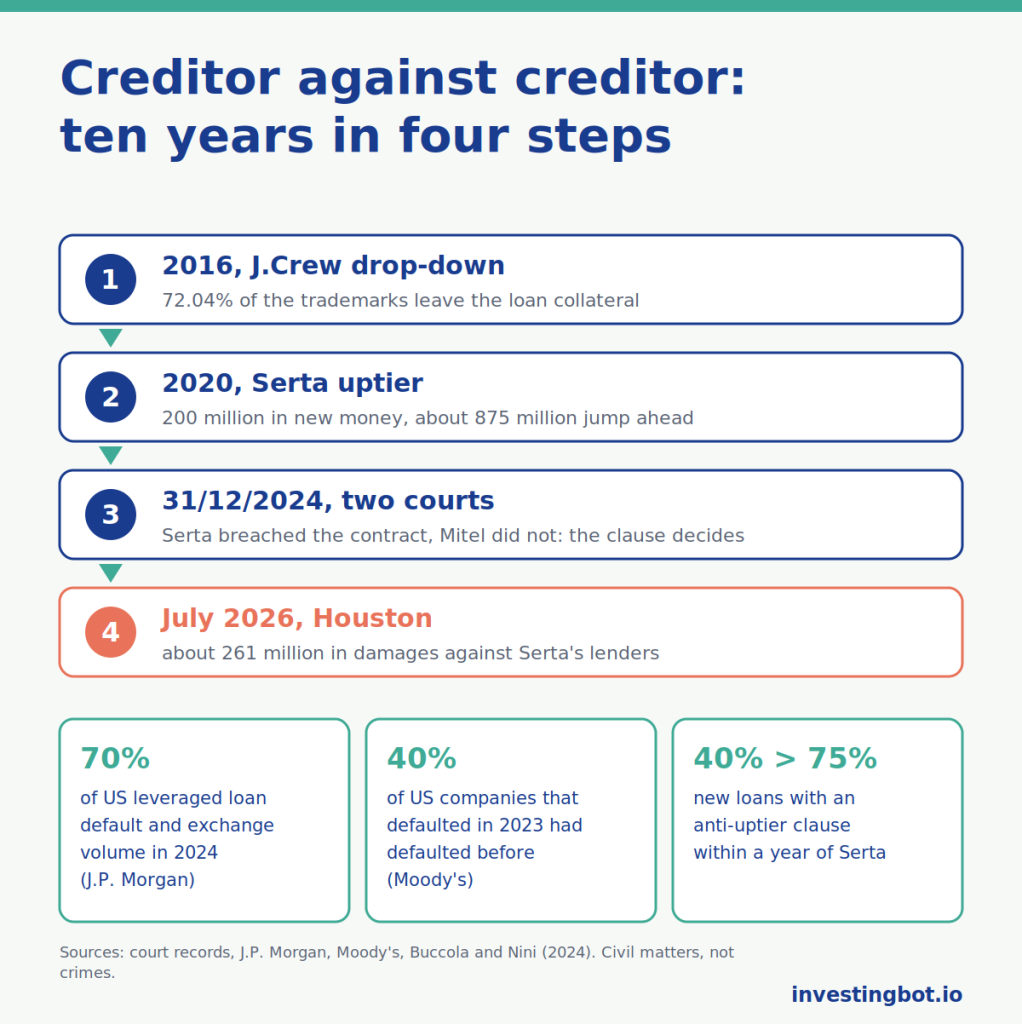
In a drop-down the company moves valuable assets into a subsidiary that does not guarantee the existing loan, and uses them as collateral for new debt. The case that gave its name to the whole thing is J.Crew, the American clothing chain. In 2016, using the exceptions in its agreement, J.Crew transferred 72.04% of its trademarks, valued at about 250 million dollars, first to a subsidiary and then to a company outside the collateral perimeter. The trademarks were licensed back to J.Crew itself and used as collateral for new bonds.
The lenders of the original loan found themselves with a company that had moved its most valuable assets beyond their reach. The episode entered the vocabulary: since then many agreements contain a «J.Crew blocker», a clause that forbids moving intellectual property this way. J.Crew filed for Chapter 11, the US restructuring procedure, anyway in May 2020.
The uptier: the Serta case, 2020
In an uptier no assets are moved: the order of creditors changes. In 2020 Serta Simmons, an American mattress maker, struck a deal with a majority of its lenders: they put in 200 million dollars of new money and exchanged their old claims for about 875 million of new debt with higher priority. The lenders left out of the deal, including large managers such as Apollo and Angelo Gordon, found themselves further back in the repayment line despite having the same contract.
Serta used the exception in its agreement that allowed it to buy back loans «on the open market». On 31 December 2024 the federal Court of Appeals for the Fifth Circuit ruled that an exchange negotiated privately with some lenders is not an open market purchase. In July 2026 the Houston bankruptcy court ordered the participating lenders to pay about 261 million dollars in damages, about 400 million with interest.
Two courts, two answers
On the same 31 December 2024 a New York State appellate court decided the case of Mitel, a telecommunications company that had done a similar uptier, the opposite way: the transaction was lawful, because that agreement allowed the company to buy back loans at any time. What changed the outcome was not the transaction but the wording of the contract.
That is the very definition of a grey area. None of these transactions is a crime: the question is whether they comply with or breach a contract, and the answer depends on a few words written years earlier. The risk for those who arrange them is civil, an order to pay damages, not criminal.
How widespread it is
These are not isolated cases. According to J.P. Morgan, in 2024 a record 70% of default and exchange volume on US leveraged loans came from distressed exchanges, that is transactions of this kind, rather than from classic defaults. And according to Moody’s, about 40% of the US companies that defaulted in 2023 had already done so before: these transactions often do not save the company, they postpone the problem.
What the research says
Vincent Buccola (Wharton School, University of Pennsylvania) and Greg Nini (Drexel University), in «The Loan Market Response to Dropdown and Uptier Transactions» (Journal of Legal Studies, 2024), looked at how contracts changed after J.Crew and after Serta. After Serta the share of new loans with a clause forbidding uptiers rose quickly: in the working version of the study, from about 40% to about 75% in a year. After J.Crew, by contrast, the clauses against drop-downs changed little.
Their reading: the market draws a distinction. Leaving the company some freedom to move collateral can have value, because in a crisis it lets it find money; a transaction that chooses which creditors to sacrifice, on the other hand, the market moved at once to forbid.
What it means for the small investor
These transactions mainly involve unlisted companies, often owned by private equity funds. But the small investor reaches them by other routes:
- ETFs on leveraged loans and high-yield bonds hold exactly this debt: a fund left out of a deal absorbs the loss, and whoever owns its shares sees it in the return;
- shareholders of a listed company that does such a transaction buy time, but a company that has already done a distressed exchange has a good chance of doing it again;
- whoever buys individual bonds rarely reads the contract: the protection they think they have can depend on a clause they do not know about.
We explain the differences between a bond ETF and a bond bought directly in a separate guide on bond ETFs and direct bonds; and how the debt of a company in crisis can end up in the hands of someone who wants to take it over is told in the article on vulture funds. On every stock page on InvestingBot you find the ratio between debt and operating profit and interest coverage: the two numbers that say how close a company is to having to negotiate with its creditors.
In short
- In creditor-on-creditor transactions a group of lenders strikes a deal with the company to jump ahead of the others.
- The drop-down moves assets out of the collateral, as J.Crew did with 72.04% of its trademarks in 2016.
- The uptier changes the order of creditors, as Serta did in 2020 with 200 million of new money.
- They are civil matters, not crimes: Serta was judged a breach of contract, Mitel was not, on the same day.
- In 2024 they reached 70% of default and exchange volume on US leveraged loans, according to J.P. Morgan.
- Small investors meet them through ETFs on leveraged loans and high-yield bonds.
What does «creditors against creditors» mean?
These are transactions in which a company in trouble strikes a deal with some of its creditors, who obtain better collateral or priority at the expense of the other creditors left out of the deal.
What is an uptier?
It is a transaction in which a majority of lenders exchange their claims for new debt that is repaid first, often adding new money. The excluded lenders move down the repayment line despite having the same contract.
What is a drop-down?
It is a transaction in which the company moves valuable assets into a subsidiary that does not guarantee the existing loan, and uses them as collateral for new debt. The best-known case is the transfer of J.Crew’s trademarks in 2016.
Are these transactions legal?
They are not crimes: the question is whether they comply with the loan agreement. In the Serta case an appeals court said no and the participating lenders were ordered to pay damages; in the Mitel case another court said yes.
Why do they concern small investors too?
Because ETFs on leveraged loans and high-yield bonds hold exactly this debt, and a creditor left out of a deal absorbs a loss that shows up in the fund’s return.
How can I tell if a company risks such a transaction?
The signals are those of debt that is hard to sustain: a high ratio between debt and operating profit and earnings that barely cover interest. A company that has already done a distressed exchange has a good chance of doing it again.