



Artificial intelligence, clean energy, robotics, cybersecurity, lithium, uranium, video games: for almost every idea that makes the headlines there is an ETF promising to turn it into an investment. It trades like a stock, holds dozens of companies, and seems to combine two attractive things: the diversification of a fund and the compelling story of a trend that will change the world. The buyer usually reasons like this: “I don’t know which company will win, but the industry will grow, and with the ETF I get them all.”
Academic research and industry statistics say this reasoning has a flaw: a thematic ETF is diversified within the theme, but the theme itself is a concentrated bet, and it is almost always bought at the wrong price. On average thematic funds are launched when the theme is already expensive, most of them close before they grow up, and those that survive behave more like a single volatile stock than like the market. In this article we lay out the research, with the names of the people who did it, and a measure built on our own data: the 11 sector ETFs that together make up the S&P 500 compared with 140 US thematic ETFs still trading.
Three families of ETFs that look alike and are not
Technically, an ETF tracking the whole US market, one tracking a sector and one tracking a theme are the same instrument: a basket of stocks listed on an exchange. What changes is what is inside, and it changes a lot.
A whole-market ETF, such as those on the S&P 500, owns all the large companies in proportion to their stock market weight. It does not choose: it takes the market as it is, winners included. A sector ETF, such as the 11 SPDR funds that split the S&P 500 into technology, financials, health care, energy, consumer, industrials, materials, utilities, real estate and communication services, takes a slice of the market according to a stable, public classification. Put together, the 11 sectors rebuild the index almost exactly: if one does worse than average, another must do better.
A thematic ETF does something different: it selects the companies that, according to an index built for the purpose, “represent” a trend, often picking them across several sectors and countries, and often holding only a few dozen names. The theme is not a slice of the market but a choice, and someone decides when to launch it. That is where the problem begins.
Launched when the theme is already expensive
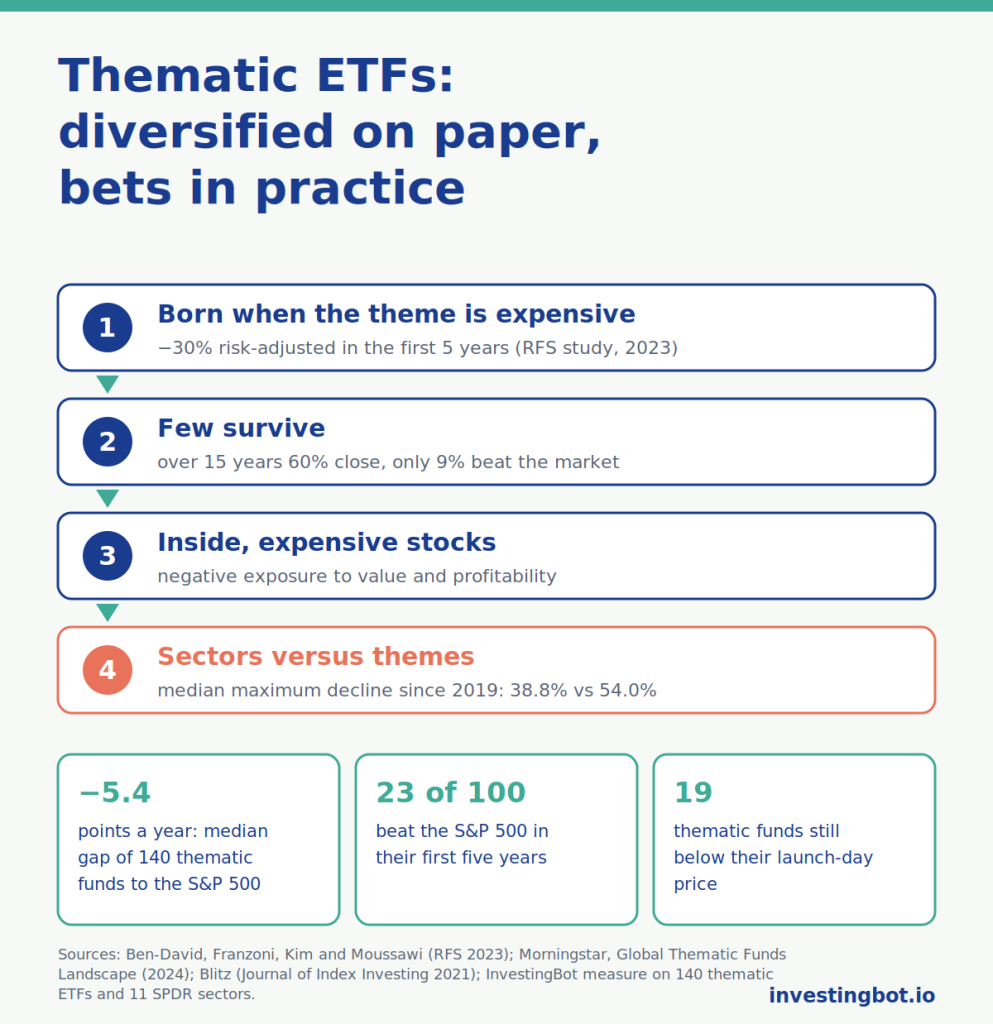
The reference study is “Competition for Attention in the ETF Space”, published in 2023 in the Review of Financial Studies by Itzhak Ben-David (Ohio State University), Francesco Franzoni (Università della Svizzera italiana and Swiss Finance Institute), Byungwook Kim and Rabih Moussawi (Villanova University). The authors note that early ETFs invested in broad indexes and offered diversification at low cost, while more recent ones track niche portfolios and charge more. And they measure what happens after launch: over their first 5 years, specialized ETFs lose about 30% on a risk-adjusted basis.
The most interesting part is the explanation. It is not the fees, which are higher but not enough to explain such a loss, and it is not demand for hedging. It is the timing of the launch: when a thematic ETF is born, the stocks it holds are already overvalued, because the theme has just had a great run and is drawing the attention of the press and of investors. Issuers, the authors write, cater to people who project recent gains into the future: they launch the product when demand peaks, that is, when the price is high. Whoever buys the story also buys the price.
One detail makes the trap more insidious. Many thematic ETFs track new indexes, created for the occasion, whose past is reconstructed on paper by applying today’s rules to earlier years. That historical return, often brilliant, was never earned by anyone: it is the return of an idea chosen precisely because it worked in the recent past.
Few survive, even fewer beat the market
The most complete census is the “Global Thematic Funds Landscape” report by Morningstar, whose 2024 edition is signed by Kenneth Lamont and other analysts at the firm. With data to June 2024, the report looks at the thematic funds available worldwide at the start of each period and counts how many are still alive and have done better than global equities. Over 15 years, 60% of thematic funds were closed, and only 9% survived while beating the market. Over 3 years one fund in 20 managed it, over 5 and 10 years about 16%.
Closure is a risk that ETF buyers rarely consider. When a fund closes, everything is not automatically lost: the fund sells its holdings and returns the value. But it usually returns it after the theme has fallen out of favour, that is, after the decline, and that loss becomes final. Whoever had bought while waiting for a recovery no longer has anything to wait with.
A hidden exposure: expensive, less profitable stocks
What does a thematic index actually hold? David Blitz, then head of research at Robeco, asked that question in “Betting Against Quant: Examining the Factor Exposures of Thematic Indices”, published in 2021 in the Journal of Index Investing. Analysing 48 thematic indices from S&P and MSCI with the tools of factor research, he found that nearly all of them have a strongly negative exposure to two characteristics the literature associates with higher expected returns: value, meaning low prices relative to earnings and book value, and profitability. In other words, buying a theme means buying, on average, expensive and less profitable companies: the opposite of what decades of research point to as advantageous. The author himself warns against generalizing beyond the two index providers he studied, but the direction is clear.
It is the same mechanism described in our article on retail investors and US stocks: stocks in the spotlight, those that look like a lottery ticket, tend to return less than average precisely because everyone wants them. A thematic ETF puts a few dozen of them together and sells them in a package that looks prudent.
The timing problem: people buy after the rise
Even when a theme does well, the people who invest in it often do not benefit. A study of the accounts of a large German broker documented this: “Abusing ETFs”, published in 2017 in the Review of Finance by Utpal Bhattacharya (Hong Kong University of Science and Technology), Andreas Hackethal (Goethe University Frankfurt) and two other authors. Clients who used ETFs did not get better results than those who did not, for two reasons: they bought and sold at the wrong moments, and they chose more expensive, less diversified ETFs instead of broad, cheap ones. The authors conclude that no group of investors would have lost by sticking to cheap, well-diversified ETFs.
With themes the effect is amplified, because inflows arrive almost entirely after the gains: it is precisely the recent strong performance that makes the fund known. Morningstar’s analyses of the gap between fund returns and investor returns find, in thematic funds, a much wider gap than in diversified equity funds. The fund may even have a good ten-year return; the average investor, who came in after the rise and left after the fall, saw only part of it. We discuss this in our article on market timing as well.
Our measure: sectors versus themes
We compared the 11 SPDR sector ETFs, the funds that split the S&P 500 into its sectors (XLK, XLF, XLV, XLY, XLP, XLE, XLI, XLB, XLU, XLRE, XLC), with all US thematic equity ETFs still trading. To identify them we set a rule on the fund’s name in advance: words such as artificial intelligence, robotics, clean energy, solar, lithium, uranium, cybersecurity, cloud, genomics, blockchain, video games, space, cannabis, water, innovation. Then we removed by hand, looking only at the name and never at returns, the funds the rule caught by mistake: managed futures strategies, volatility products, funds that use artificial intelligence to pick stocks without having it as a theme, size-based funds and aerospace and defense industry funds. We also excluded leveraged, inverse and options-based funds. That leaves 140 thematic ETFs with at least two years of history. Prices include reinvested dividends, from each fund’s inception to 21 October 2026, always compared with the S&P 500 (the SPY ETF) over the same days.
One limit must be stated up front, and it favours themes: we could only measure funds still trading. Closed ones, which according to Morningstar are the majority, are missing, and they would have made the results worse.
Over their whole life
From launch to today, the median sector fund returned 0.5 points a year less than the S&P 500, and 5 sectors out of 11 beat it: around the market, as expected from pieces that together are the market. The median thematic fund returned 5.4 points a year less than the S&P 500, and only 33 out of 140 beat it, fewer than one in four. 19 thematic funds are still below their launch-day price; the extreme case is the solar ETF listed since 2008, which lost 7.7% a year on average, with a maximum decline of 95.2%. None of the 11 sector funds is below its starting price.
The first five years after launch
Repeating the idea of Ben-David and colleagues on our data, we looked at the first five years of the 100 thematic funds that have already completed them, compared with the S&P 500 over the same five years. The median fund returned 4.9 points a year less than the index, and only 23 out of 100 did better. These are survivors: funds closed in the meantime are not counted. It is the same sign found by the academic study, measured more simply and on a sample that by construction is the best possible one.
Over the same seven-year window
Comparing different periods can mislead: most sector funds have existed since 1998, while thematic funds were born mostly after 2014. So we also looked at a common window, from 31 October 2019, for the 78 thematic funds that already existed then, in a period when the S&P 500 gained 181.7% (16.0% a year). In these years the index was driven by a few large technology companies, and almost every piece taken separately fell behind: sector funds by 4.6 points a year at the median, thematic funds by 5.7. 2 sectors out of 11 and 20 thematic funds out of 78 beat the index.
The sharpest difference lies in the risk endured to get that result. Over the same window the median maximum decline was 38.8% for sector funds and 54.0% for thematic funds. In seven years, with the market nearly tripling, about one thematic fund in four did better: but to find out which one, you had to pick it in advance, and endure declines of more than half its value.
Getting stuck
The fear of being stuck in an ETF that does not recover is borne out by the numbers. Today the median thematic fund is 16.1% below its all-time high, the median sector fund 6.6%. Sectors, however, can also demand a lot of patience: the technology ETF took 16.9 years to get back above the peak of the 2000 bubble, and the financials ETF 10.1 years to get back above its 2007 peak. The difference is that a sector is part of the economy by definition and sooner or later gets carried along by the market; a theme can simply go out of fashion. The most famous case, the ARKK fund, has returned almost exactly as much as the S&P 500 since 2014 (13.7% a year against 13.8%), but through a decline of 80.9%, and it is still 44.5% below its high: whoever bought at the 2021 peak has not recovered.
Why a sector is not a theme
The measure suggests a useful distinction. A sector ETF is a bet on the relative weight of a part of the economy: you can be wrong, but the sector exists regardless of fashion, is classified with stable criteria, also contains dull and profitable companies and, added to the others, rebuilds the market. That is why on average it returns about what the market does, with wider swings.
A thematic ETF is a bet on a story: stock selection is narrower, it leans towards more expensive and less profitable companies, the product is born when the story is already in the papers, and if the story fades the fund may close. It is no coincidence that, among the best-known thematic funds, the best results come from themes that largely coincide with the technology core of the market, such as cybersecurity and artificial intelligence, and the worst from themes that were for a while “the next big thing”, such as solar, clean energy and uranium.
In this sense, the intuition that a thematic ETF resembles a single stock more than a diversified fund is right on two counts out of three: in the depth of its declines and in the risk of not recovering. On the third, the dispersion of results, it sits halfway: less extreme than a single stock, far more than a broad index.
What this means for investors
- The core of the portfolio can stay in the whole market: it already contains every theme, including those nobody talks about today that will be tomorrow’s winners.
- Treat a theme as a bet: with a small part of your wealth, chosen knowing the result may be much better or much worse than the market, and that it may take a decade to recover from a decline.
- Be wary of past returns in the shop window: if the index is new, the earlier numbers are a reconstruction, and if the theme has run a lot the entry price is probably high.
- Look inside the fund: how many stocks it holds, how much the top ten weigh, what it costs and how much it overlaps with what you already own.
- A sector is not a theme: to express a view on a part of the economy, a broad and cheap sector ETF is on average a less extreme bet than a narrow theme.
This article is for information only and is not financial advice: tax rules and investor protection differ from country to country, and every decision should be assessed against your own situation.
In brief
- Over their first 5 years, specialized ETFs lose about 30% on a risk-adjusted basis, because they are born when the theme’s stocks are already overvalued (Ben-David, Franzoni, Kim and Moussawi, 2023).
- Over 15 years, 60% of thematic funds were closed and only 9% survived while beating global equities (Morningstar, 2024).
- Thematic indices tend to tilt towards expensive and less profitable companies, the opposite of what research associates with higher expected returns (Blitz, 2021).
- Investors who use ETFs often buy and sell them at the wrong moments and choose the more expensive ones (Bhattacharya, Hackethal and co-authors, 2017).
- In our measure, over their whole life the 11 SPDR sector funds are 0.5 points a year below the S&P 500 at the median, the 140 thematic funds still trading 5.4 points; in the first five years after launch thematic funds lose 4.9 points a year against the index.
- Over the same window since 2019 sectors fall behind by 4.6 points a year and themes by 5.7, but the median maximum decline is 54.0% for themes against 38.8% for sectors.
- 19 thematic funds out of 140 are still below their launch price; no sector fund is.
Is a thematic ETF diversified?
Only within the theme. It holds dozens of stocks, but all tied to the same story, often among the most expensive in the market. If the theme falls out of favour with investors they fall together, and the fund can lose more than half its value, like a single stock.
Why do thematic ETFs often return less than the market?
Mostly because of when they are born: according to Ben-David, Franzoni, Kim and Moussawi they are launched when the theme’s stocks are already overvalued, and over their first five years they lose about 30% on a risk-adjusted basis. Higher costs and investors’ tendency to buy them after gains also matter.
How many thematic funds survive?
According to Morningstar’s 2024 report, over the previous 15 years 60% of thematic funds were closed and only 9% survived while beating global equities. When a fund closes it returns the remaining value, usually after the theme has already fallen.
Are sector ETFs safer than thematic ones?
They are not safe, but they are less extreme. In our measure, over the same seven-year window sectors fell behind the S&P 500 by 4.6 points a year and themes by 5.7, but the median maximum decline was 38.8% for sectors and 54.0% for themes. The 11 sectors together rebuild the market; themes do not.
Can a thematic ETF recover after a sharp fall?
It can, but it is not guaranteed and it can take a long time. In our measure 19 of the 140 thematic funds still trading are below their launch price, one of them for eighteen years. A sector can also take a decade, like technology after 2000, but a sector remains part of the economy, while a theme can go out of fashion or the fund can close.
Why do the historical returns of thematic ETFs look so high?
Often because the index is new and its past is reconstructed by applying today’s rules to earlier years, choosing a theme that has just had a great run. No real investor ever earned that return.
Does it make sense to buy a thematic ETF?
It can, as a conscious bet, with a small part of your wealth and a long horizon, alongside a core invested in the whole market. First it is worth checking how many stocks it holds, how much the top ten weigh, what it costs and how much the theme has already risen.