



A share gives you two things at once: the right to vote and the risk of gaining or losing with the price. With today’s financial instruments the two can be separated. Whoever votes may have nothing left to lose, or may even gain if the company does badly; whoever really holds the risk can stay hidden. Legal scholars call this empty voting, and it applies to creditors too: a bondholder protected by insurance against default may prefer the company to fail.
Empty voting, in a nutshell
At a shareholder meeting the assumption is that whoever votes wants the company to do well: if the price falls, they lose too. Empty voting breaks that assumption. An investor can have more votes than economic interest, because they have hedged the risk of their shares with other contracts; in extreme cases their interest is negative, and they gain if the company loses value.
The phenomenon has a twin: hidden ownership. Here the opposite happens: an investor holds all the economic risk of a block of shares through derivatives, but does not formally own them, so they do not have to disclose them, and if needed they can have them delivered and vote them.
How the vote is separated from the risk
There are three tools, all legal and in everyday use:
- securities lending: whoever borrows a share also gets its vote, while the economic risk stays with the lender. If the loan covers the record date, the day that fixes who is entitled to vote, the vote passes to someone who risks nothing;
- hedging with derivatives: you buy the shares and at the same time sell their risk through a swap or options, so you remain a shareholder in name but not in substance;
- total return swaps: you receive all the gain or loss on a block of shares without owning them; the shares are bought by the counterparty bank to hedge itself.
Used to protect against risk, they are ordinary tools. They become a problem when they serve to vote without risk or to take risk without disclosing it: that is where you move from legal to the grey area, and sometimes to the unlawful.
The Mylan and King case, 2004
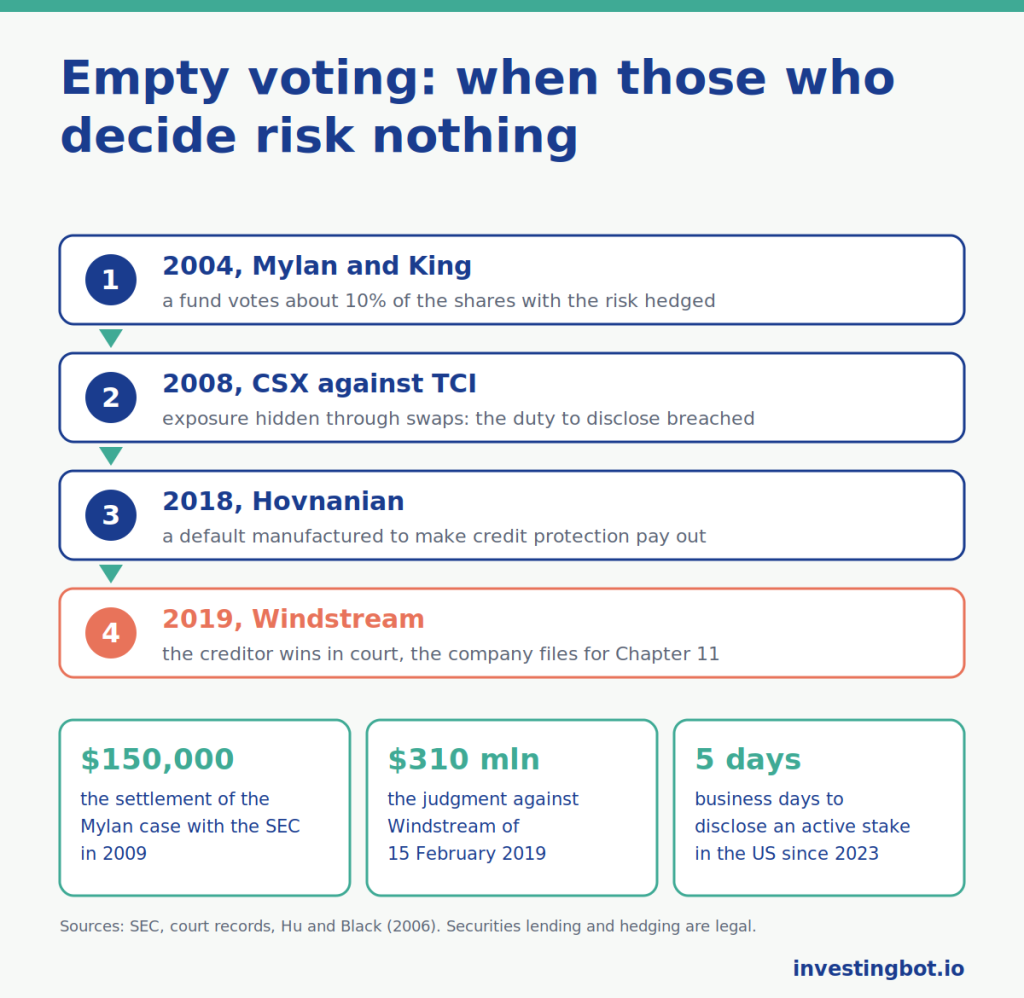
The case that made the term famous dates from 2004. Mylan, an American pharmaceutical company, wanted to buy King Pharmaceuticals. The fund Perry Corp owned many King shares and had every interest in the deal going through. So it bought about 10% of Mylan’s shares to be able to vote in favour, and hedged all of their risk with derivatives: it had the votes of a large Mylan shareholder, but no interest in Mylan paying a fair price.
The acquisition did not happen in the end. In 2009 the SEC, the US markets regulator, settled with Perry for $150,000, without any admission of wrongdoing: the charge was not empty voting itself, which no rule prohibited, but the form the fund had used to disclose its stake, the one reserved for passive investors. That is the very definition of a grey area: the conduct that worried people most was not prohibited, and the penalty came over a disclosure question.
Hidden ownership: CSX against TCI, 2008
In 2008 the British fund The Children’s Investment Fund (TCI) was fighting for seats on the board of the American railroad CSX. For years it had built up economic exposure to a large part of the capital through total return swaps with several banks, which bought the real shares to hedge themselves. The fund did not disclose them, because formally it did not own them.
In June 2008 federal judge Lewis Kaplan in New York ruled that TCI had breached its duty to disclose significant holdings, because it had structured the swaps precisely to avoid appearing as the owner. But he refused to cancel the votes of the shares built up during that period. Here the line was crossed: it is unlawful, even if civil and with no consequences for the vote.
The empty creditor: who gains if the company fails
The same mechanism works for debt. A fund can own a company’s bonds and at the same time buy credit default swaps, contracts that pay out if the company does not repay. If the protection is worth more than the bonds, the fund is better off if the company fails: it is a creditor with a negative interest.
The most cited case is Windstream, an American telecom company. The fund Aurelius, which had bought its bonds, took it to court arguing that a 2015 transaction breached the bond contract. On 15 February 2019 federal judge Jesse Furman ruled in its favour and ordered Windstream to pay about $310 million. About ten days later the company filed for Chapter 11, the US restructuring procedure. Windstream accused the fund of acting to cash in on its default protection; the ruling, however, decided only on the breach of contract.
The manufactured default: Hovnanian, 2018
The opposite case is the manufactured default: instead of pushing a company into bankruptcy, you persuade it to miss a payment on a technicality. At the end of 2017 the fund GSO, part of the Blackstone group, which according to press reports had bought protection worth over $300 million on the American homebuilder Hovnanian, offered it financing on good terms. Among them was skipping the interest on a small block of bonds held by a company linked to the fund itself: a minimal default, but enough to trigger the protection payout.
The fund Solus, which had sold that protection, sued. In April 2018 the CFTC, the US derivatives regulator, said it was examining whether manufactured defaults amounted to market manipulation. On 30 May 2018 the case was closed and Hovnanian paid the skipped interest. In July 2019 ISDA, the association that writes the rules for derivatives, changed the definition of failure to pay: from January 2020 a default only counts if the company is genuinely in difficulty.
What the research says
The term «empty voting» comes from Henry Hu (University of Texas at Austin) and Bernard Black (now at Northwestern University), in «The New Vote Buying: Empty Voting and Hidden (Morphable) Ownership» (Southern California Law Review, 2006). Their point: company law takes for granted that vote and risk go together, while derivatives make it cheap to separate them, and disclosure rules do not see it.
On the securities lending market, Susan Christoffersen, Christopher Geczy, David Musto and Adam Reed, then at McGill University, the Wharton School and the University of North Carolina, showed in «Vote Trading and Information Aggregation» (Journal of Finance, 2007) that lending shares around the record date is a real market for votes. The average price of a vote is close to zero, but trading rises at companies that have done worse and when the vote is contested: exactly where a vote matters most.
What this means for retail investors
The rules have moved. In 2023 the SEC shortened the deadline for disclosing a significant stake with active intentions to 5 business days, down from 10 days, and also required derivatives linked to the company’s shares to be reported. But empty voting as such remains largely legal. For investors it means three things:
- a vote at a meeting does not tell you which side the voter is on: a large shareholder backing a deal may have nothing to lose if it goes badly;
- if your fund lends out its securities, which is common for ETFs, around the record date the votes of its shares may pass to someone else;
- in a restructuring, not all creditors want to save the company: one covered by default protection may gain more from a bankruptcy.
How a creditor can strike a deal with the company to jump ahead of the others is told in the article on creditor against creditor; how the debt of a company in crisis can end up with someone who wants to take it over, in the one on vulture funds. On every InvestingBot stock page you will find the share held by institutions and insider transactions: they do not show derivatives, but they tell you who stands behind a company.
At a glance
- Empty voting separates the right to vote from economic risk: you can vote without risk, or gain if the company does badly.
- The tools are legal and common: securities lending, hedging with derivatives, total return swaps.
- In the 2004 Mylan case a fund voted about 10% of the shares without bearing their risk; the SEC settled it in 2009 for $150,000 over a disclosure question.
- In 2008 a judge ruled that TCI had unlawfully hidden its exposure to CSX through swaps.
- With debt, a creditor protected against default may want bankruptcy, and a default can even be manufactured, as in the 2018 Hovnanian case.
- Since 2023 active stakes in the United States must be disclosed within 5 business days, derivatives included.
What is empty voting?
It is the situation where someone voting at a meeting has more votes than economic interest in the company, because they have hedged the risk of their shares with other contracts. In extreme cases their interest is negative and they gain if the company loses value.
What is hidden ownership?
It is the opposite case: an investor holds all the economic risk of a block of shares through derivatives but does not formally own them, so they are not required to disclose them, and if needed they can have them delivered.
Is empty voting legal?
Largely yes: securities lending and hedging with derivatives are legal tools. It becomes unlawful when it serves to hide a stake that should have been disclosed, as established in the CSX against TCI case of 2008.
What is a manufactured default?
It is a technical default agreed with the company to make credit default swaps pay out to their holders. After the 2018 Hovnanian case ISDA changed the rules: since 2020 a missed payment only counts if the company is genuinely in difficulty.
Can my ETF lend out my votes?
Many funds lend the securities they hold to earn a fee. If the loan covers the record date of a meeting, the vote on those shares passes to whoever borrowed them.
How can I spot it?
Not always: derivatives are often not public. Disclosures of significant stakes help, which in the United States since 2023 must also report derivatives, as does news on who supports or opposes a deal and why.