



You have a sum to invest, and the question asks itself: all at once, or a bit at a time so as not to get the moment wrong? The short answer is that going in with a single payment finished ahead in 71% of cases across a century and a half of market history. But the number that really changes the decision is a different one, and it is less comfortable: drip-feeding did not protect you from losses — it merely moved them. This guide shows both calculations, made on the same data, including the one that contradicts the very reason most people choose to spread their entry.
What a century and a half of market history says
We compared two ways of investing the same amount across 1,830 consecutive months of the US market, from 1871 onwards, with dividends reinvested: on one side a single lump-sum payment, on the other the same amount split into twelve equal monthly instalments. Then we looked at which one ended higher.
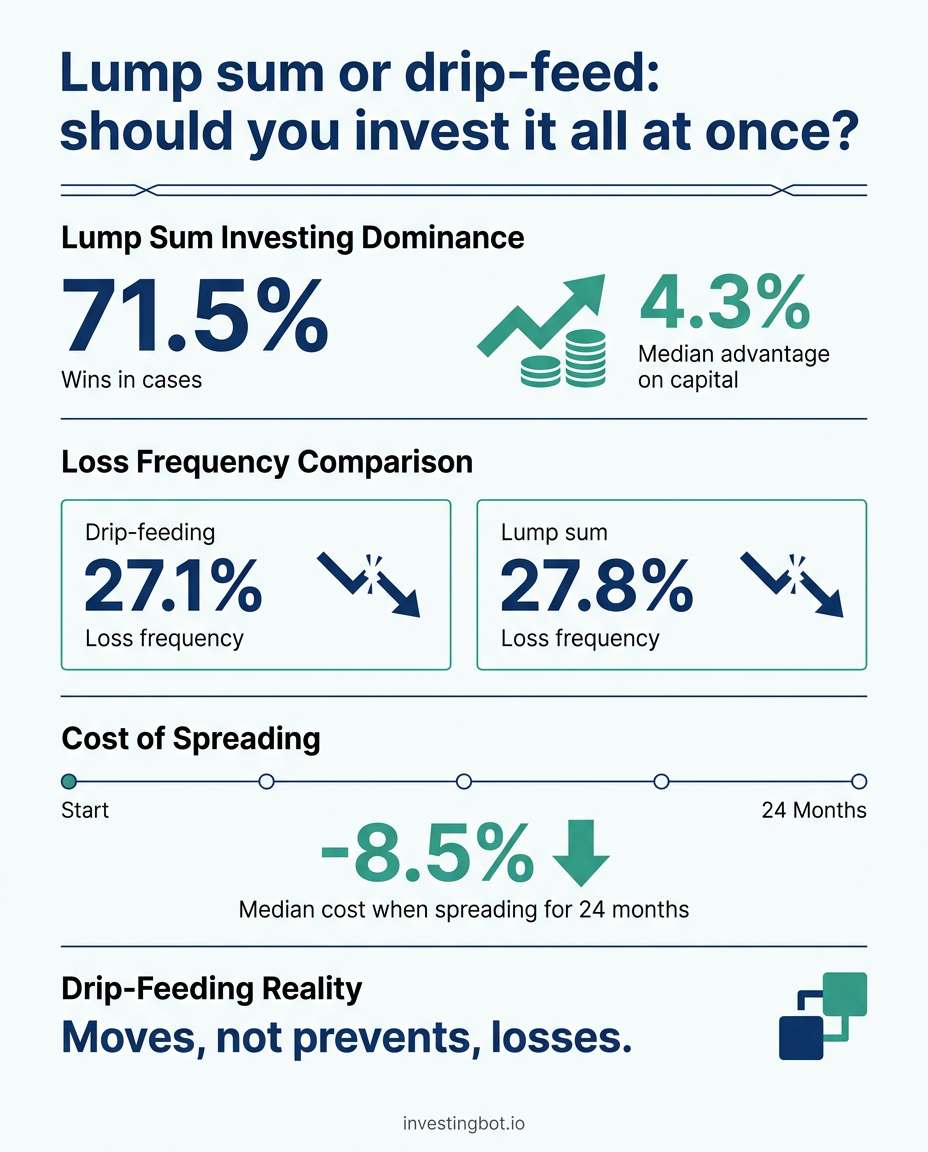
The result: the lump sum finishes ahead in 71.5% of windows, with a median advantage of 4.3% on the final capital. It is not a crushing victory, and it matters to see the tails as well:
| How drip-feeding did against the lump sum | Difference in final capital |
|---|---|
| In the worst 5% of cases for drip-feeding | −15.7% |
| A quarter of the time, worse than | −9.2% |
| In half of cases (median) | −4.3% |
| A quarter of the time, better than | +1.2% |
| In the best 5% of cases for drip-feeding | +12.8% |
The extremes tell the rest. The best starting points for spreading the entry were those of 1931, in the depths of the Great Depression: there, drip-feeding closed up to 74% above the lump sum. The worst were those of 1933, just after the bottom, where spreading the entry cost 35%. Put another way: drip-feeding wins when the market falls straight afterwards and loses when it rises. Which is obvious — and therefore no help in deciding.
But does drip-feeding protect you from losses?
This is the reason almost everyone chooses it, so it is worth measuring rather than assuming. We counted how often, after twelve months, each strategy found itself below the amount invested.
The lump sum ends in loss in 27.8% of windows. Drip-feeding, in 27.1%. Seven tenths of a percentage point apart, across a century and a half.
The detail is starker still. Spreading the entry avoided a loss in 5.2% of windows — and caused one in 4.5%, meaning cases where the lump sum would have ended in profit. The two figures very nearly cancel out. Drip-feeding does not reduce the chance of losing: it changes which cases you lose in.
Spreading it out further makes things worse
If twelve months cost something, twenty-four ought to cost twice as much — and the data says exactly that, without exception.
| Instalments | How often the lump sum wins | Median cost of spreading |
|---|---|---|
| 6 months | 67.7% | −2.2% |
| 12 months | 71.5% | −4.3% |
| 24 months | 75.5% | −8.5% |
| 36 months | 79.3% | −12.2% |
The reason is simple and has nothing to do with forecasting: the longer you spread, the longer part of your capital sits idle in a market that has historically risen more often than it has fallen. Anyone lengthening the plan to feel safer is buying that comfort on rising instalments.
The detail almost nobody notices
One thing only shows up when you measure it, and it changes how you think about the choice: the gap between the two strategies forms during the months of the instalments, and then never changes again.
In our calculation, the gap between investing everything at once and spreading over twelve months is identical to the fourth decimal place whether measured at one year, two, five, ten or twenty. The reason is trivial once stated: after the final instalment, both portfolios are 100% invested in the same thing, so from then on they grow at the same rate.
That has a practical consequence: you are not choosing how your investment will do over the next twenty years. You are choosing an advantage or a disadvantage that is settled within twelve months, and then carried forward, compounded, for good.
Can you tell in advance when spreading will pay off?
If drip-feeding pays off when the market is about to fall, it would be enough to spread the entry only when the market is expensive. We tested that using the ten-year price/earnings ratio — the classic valuation yardstick, available at the moment of the decision rather than with hindsight.
It does not work. Splitting every window into five groups by valuation, the lump sum wins in 77.6% of cases when the market is at its cheapest and 71.5% when it is at its most expensive. There is a difference, but it runs against intuition: even starting from the most stretched valuations, spreading the entry remained behind in almost three cases out of four. The link between valuation and the merits of drip-feeding is close to nil.
It is the same wall you hit when trying to guess the lows, which we covered in why predicting the bottom is nearly impossible.
How much this choice matters, in the end
Here is the comparison that puts it all in proportion. In the vast majority of cases, the choice between the two entries moves the final capital by a few percentage points: it exceeds 10 points in only 29.6% of windows, and 20 points in 3%. Once, at the start.
How long you stay invested, by contrast, changes everything — every year:
| Horizon | Worst annual return | Median | Best |
|---|---|---|---|
| 1 year | −62.3% | +10.8% | +139.8% |
| 5 years | −17.3% | +9.6% | +33.7% |
| 10 years | −4.0% | +8.7% | +21.2% |
| 20 years | +2.0% | +8.1% | +17.9% |
| 30 years | +3.6% | +9.9% | +14.3% |
Over one year the spread between best and worst case is 202 percentage points. Over thirty it narrows to 10.7, and even the worst case is positive. Time compresses uncertainty; the way you enter does not. If you are giving more thought to the month of entry than to the length of the plan, you are looking at the less important variable.
So when does spreading the entry make sense
The honest answer is that drip-feeding is not a technical choice: it is a choice about your own stomach. And it can be entirely reasonable in three situations.
When the sum is large relative to what you own
Investing in one go an amount that represents most of your wealth means the first year will decide how you feel for the next five. The median cost of spreading — a little over 4% — is the price of that calm, and it is a price you may knowingly choose to pay.
When you know you would sell at the first crash
This is the most important case, because the real risk is not 4% less return: it is abandoning the plan. A worse strategy you can stick to beats a better one you abandon after six months. If you know that a −25% in the first year would make you sell, spreading the entry is a way of buying the odds of staying.
When you do not actually have a sum to invest
There is a common confusion worth clearing up: if you invest whatever you manage to save each month, you are not choosing between the two strategies. You are simply investing as soon as you have the money, which is all you can do — and that is the case of a genuine regular savings plan. The comparison in this article applies only to someone who already has the sum in hand and has to decide what to do with it.
The limits of this calculation
They need stating, because they change how the numbers read.
The first concerns where the money sits while it waits. In the figures above, the portion not yet invested earns nothing. If instead it earns interest — which is realistic — the lump sum’s advantage falls from 71.5% to 62.9% of cases, and the median cost of spreading from 4.3% to 2.4%. The direction never changes, but the size does: strictly speaking, the answer is that going in at once finished ahead between 63% and 71% of the time, depending on what the waiting cash earns.
The second is that this is one market, in one currency. It is the longest and best documented series available, but it is still one. The third is that the past measures what happened, not what will: 71% is not a probability, it is a historical frequency.
The last is practical and often forgotten: twelve instalments mean twelve dealing charges instead of one. On modest sums they can erode a meaningful part of the already thin advantage of spreading, in the very cases where spreading would have paid.
In short
Across a century and a half of market history, investing everything at once finished ahead roughly seven times out of ten, with a median advantage a little above 4%. Lengthening the instalments progressively worsens the result. But above all: spreading the entry did not reduce the chance of ending up in loss — 27.1% against 27.8% — and no valuation yardstick says in advance when it will pay.
If your goal is expected return, the data says go in now. If your goal is staying invested without panic-selling, spreading is a declared cost that buys discipline. Both answers are legitimate: what does not hold up is choosing to spread in the belief that it reduces the risk of losing.
And whichever you choose, that decision matters less than the years you will stay invested.
So is it always better to invest everything at once?
In 71.5% of historical windows, yes — but not in the remaining 28.5%. And the difference exceeds 10 percentage points in fewer than a third of cases. It is a real and modest advantage, not a rule that always holds.
Why is drip-feeding said to reduce risk?
Because it reduces the risk of regret, which is a different thing from the risk of losing. The data shows the chance of being underwater after a year is almost identical either way. What changes is which scenarios leave you down, not how often.
If the market is at all-time highs, is spreading better?
The data says no, or at least not enough to make a rule of it: even starting from the highest valuations, going in at once finished ahead in roughly three cases out of four. The starting level is not a good signal for deciding how to enter.
Over how many months should I spread, if I choose to?
As few as possible. The median cost rises with duration: about 2% over six months, 4% over twelve, 8.5% over twenty-four, more than 12% over thirty-six. If you are spreading to manage your emotions, pick the shortest period that lets you sleep.
Does this apply to someone investing part of their salary each month?
No, and the distinction matters. Someone paying in what they save has no sum to place: they are investing as soon as they can, which is simply the right thing to do. The comparison concerns those who already have the capital available.
What if the market crashes right after I invest it all?
It happens, and it is the 28.5% of cases where spreading would have done better. But after the final instalment the two strategies grow at the same rate: the gap forms in the first year and then stays fixed. What matters from there on is only how long you stay invested.