



The margin of safety is the gap between what you think a stock is worth and what you pay for it: if you estimate it is worth 100 and buy it at 70, your margin is 30%. It exists for one purpose, and it is the one most people forget: to protect you from your own estimation error. That is why there is no universally “right” discount: the discount has to be larger than the uncertainty about the value. In our data, one stock in six trades at a discount of at least a third — which says less about an abundance of bargains than about how wide the estimates are.
What the margin of safety is
The idea comes from Benjamin Graham, economist and professor at Columbia University, who developed it with David Dodd in Security Analysis (1934) and put it at the heart of the final chapter of The Intelligent Investor (1949), which presents the margin of safety as “the central concept of investment”. The reasoning is simple: the value of a business can only be estimated, and the estimate can be wrong. Buying well below it leaves room for the error before it turns into a loss.
The calculation is straightforward:
margin of safety = 1 − price ÷ estimated value
A stock valued at 100 and bought at 70 has a 30% margin. Bought at 95, a 5% margin. Bought at 110, the margin is negative: you are paying more than you think it is worth.
Discount and upside are not the same number
A detail that often causes confusion: the discount to value and the upside needed to get back to it are not the same. If you buy at 70 something worth 100, the discount is 30%, but the price has to rise 42.9% to reach 100.
| Discount to estimated value | Upside needed to reach value |
|---|---|
| 10% | +11.1% |
| 20% | +25% |
| 25% | +33.3% |
| One third (33.3%) | +50% |
| 50% | +100% |
A rule of thumb often associated with Graham is to buy at about two thirds of estimated value, that is, at a one-third discount. Seen from the upside, it means requiring the stock to be able to rise 50% before it reaches its value. Keeping both figures in mind stops you from mistaking a “+50%” estimate for a 50% margin.
Why it matters: value is an estimate, not a fact
What makes the margin of safety indispensable is that nobody knows what a business is worth. Every valuation method — discounted cash flows, multiples, peer comparison — rests on assumptions about the future, and different assumptions give different numbers. We covered this in our guide to why fair value is never a single number.
Seth Klarman, founder of the Baupost Group, put it most bluntly in Margin of Safety (1991): the value of a business cannot be estimated precisely, and that is exactly why you should buy at a wide discount, so that a mistake or a stroke of bad luck does not become a permanent loss. The margin is not a reward for being right: it is insurance against the possibility of being wrong.
Hence the consequence that matters: the more uncertain the estimate, the wider the margin must be. A 20% discount on a stable, predictable business may be enough; the same 20% on a company that could be worth half or double gives you no protection at all.
What our data says
We measured the gap between price and fair value across every stock we value, American and European, to see how common discounts really are.
| Across the 3,591 stocks with a fair value | Value |
|---|---|
| Trade below their fair value | 57.1% |
| Median gap between price and fair value | +6.6% |
| Discount of at least one third (Graham’s threshold) | 17.7% (637 stocks) |
| Discount of at least half | 5.9% |
| United States: below fair value / discount of at least a third | 61.2% / 14.6% |
| Europe: below fair value / discount of at least a third | 51.1% / 22.3% |
The figure that gives pause is the third one: one stock in six appears to offer Graham’s classic margin. If bargains were really that common, beating the market would be easy — and it is not. The more honest reading is different: a large share of those discounts does not measure an opportunity, it measures how wide the uncertainty around the estimate is.
The margin has to exceed the uncertainty
For every stock we publish, alongside the fair value, an uncertainty level — Low, Medium or High — that tells you how far the different valuation methods agree with each other. Here is how discounts are spread across the three classes:
| Uncertainty of the estimate | Share of stocks | Share among those with a discount of at least a third | Discount of at least a third, within the class |
|---|---|---|---|
| Low | 7.8% | 5.5% | 12.5% |
| Medium | 29.8% | 29.8% | 17.8% |
| High | 62.4% | 64.7% | 18.4% |
Two things stand out. First: nearly two stocks in three have High uncertainty, meaning valuation methods that give widely different answers. For these stocks, a one-third discount can sit entirely inside the disagreement between models: it is not a margin, it is noise. Second: one-third discounts show up at a similar rate in every class, but only 5.5% of them concern Low-uncertainty stocks. The margins that really count — wide discounts on solid estimates — are rare, as they should be.
The rule we draw from it: before looking at how big the discount is, look at how reliable the estimate is. And when uncertainty is high, reason about the range of values, not the central number. It is the same logic by which an honest range is worth more than a precise target.
When the discount is a trap
A stock can be cheap because the market is wrong — or because it is right. The situations in which a discount most often misleads:
- Earnings at the top of the cycle. In cyclical businesses (commodities, energy, heavy industry) the profits of the best years make the stock look cheap just as the cycle is about to turn. A model that projects those profits forward finds a high value and a large discount.
- A business in decline. If revenue is eroding structurally, the past overstates the future and the discount widens instead of closing.
- Debt and dilution. A heavily indebted company can look cheap on earnings, but the value to shareholders is what is left after the creditors — and it can shrink quickly.
- Wrong data. Earnings inflated by a one-off item, or a set of accounts misreported by the source, produce a high and false fair value. The more extreme the discount, the more it pays to check the data before the thesis.
In all these cases the margin of safety is apparent: it exists only on the model’s paper. That is why Graham saw it as protection, not as a buy signal.
How to use it in practice
- Start from the range, not the number. Look at the fair value together with its uncertainty. If the uncertainty is high, your reference is the low end of the range, not the middle.
- Ask for a discount proportional to the uncertainty. The more fragile the estimate, the wider the margin must be: for a predictable business less may do, for a cyclical or changing one you need much more.
- Ask why it is cheap. Before you buy, find the reason the market sees it differently. If you cannot find one, you may not have looked hard enough.
- Check the balance sheet. Debt, earnings quality, cash flow: a discount on fragile numbers is not a margin.
- Diversify. The margin of safety works on the average of many decisions, not on a single one. Even a good margin can go wrong on one stock; across twenty, probability works for you.
What the research says, and what we do not know yet
The idea of buying below value has solid empirical support. Eugene Fama and Kenneth French, both then at the University of Chicago, showed in “The Cross-Section of Expected Stock Returns” (Journal of Finance, 1992) that, in the US market, stocks priced low relative to book value had earned more on average. Josef Lakonishok (University of Illinois), Andrei Shleifer (Harvard) and Robert Vishny (University of Chicago), in “Contrarian Investment, Extrapolation, and Risk” (Journal of Finance, 1994), attributed much of that effect to investors’ habit of extrapolating the recent past for too long. And Warren Buffett, in his talk “The Superinvestors of Graham-and-Doddsville” at Columbia Business School in 1984, described the results of a group of managers trained in Graham’s school.
These are average results, across many stocks and long periods, including long stretches in which value lagged the market. They do not say that every discount will close.
The same limit applies to our own data, and we prefer to say it plainly: we do not yet have a history long enough to verify whether the discounts we measure actually close. We are recording them over time precisely so that we can measure it. Until then, fair value is an estimate with its uncertainty stated, not a return forecast.
In short
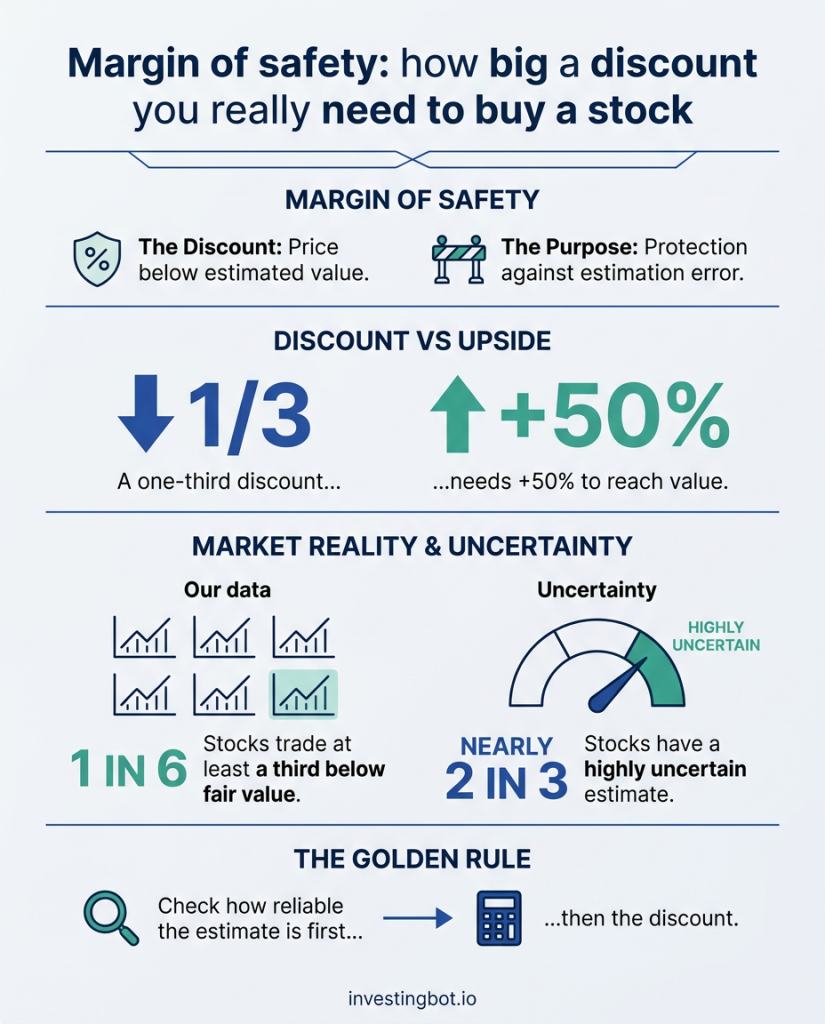
- The margin of safety is the discount between price and estimated value, and it exists to protect you from your own estimation error.
- Discount and upside are not the same: a one-third discount needs a 50% rise to get back to value.
- Across our 3,591 stocks, one in six trades at a discount of at least a third: more than bargains, it is a sign of wide estimates.
- Nearly two stocks in three have High valuation uncertainty: there, even a large discount can sit entirely inside the error.
- A discount can be a trap: peak-cycle earnings, decline, debt or wrong data.
- Rule of thumb: check how reliable the estimate is first, then the discount; and diversify, because the margin works on the average.
What is the right margin of safety?
There is no figure that fits everyone. A rule of thumb often associated with Graham is to buy at about two thirds of estimated value, that is, at a one-third discount. But the right figure depends on how reliable the estimate is: for a predictable business less may do, for one with a very uncertain value you need more.
Are margin of safety and fair value the same thing?
No. Fair value is the estimate of value; the margin of safety is the distance between that estimate and the price you pay. A fair value without a margin protects you from nothing, and a margin calculated on an unreliable fair value is only apparent.
If a stock trades at a big discount, is it a bargain?
Not necessarily. A wide discount can point to an opportunity, but also to earnings inflated by the top of the cycle, a declining business, too much debt or wrong data. The more extreme the discount, the more it pays to understand why the market sees it differently.
How do you calculate the margin of safety?
Margin = 1 − price ÷ estimated value. A stock valued at 100 and trading at 70 has a 30% margin. Be careful not to confuse it with the upside needed to reach value, which in that case is 42.9%.
Does a margin of safety eliminate the risk of losing money?
No, it reduces it. It protects against moderate estimation errors, not against everything: a business can deteriorate more than any margin allows for. That is why the concept works better across a diversified portfolio than on a single stock.
Does the margin of safety apply to ETFs too?
The concept was born for individual companies, whose value can be estimated. An ETF on a broad index has no fair value in the same sense: there, protection comes mainly from diversification, low costs and the time you stay invested.