



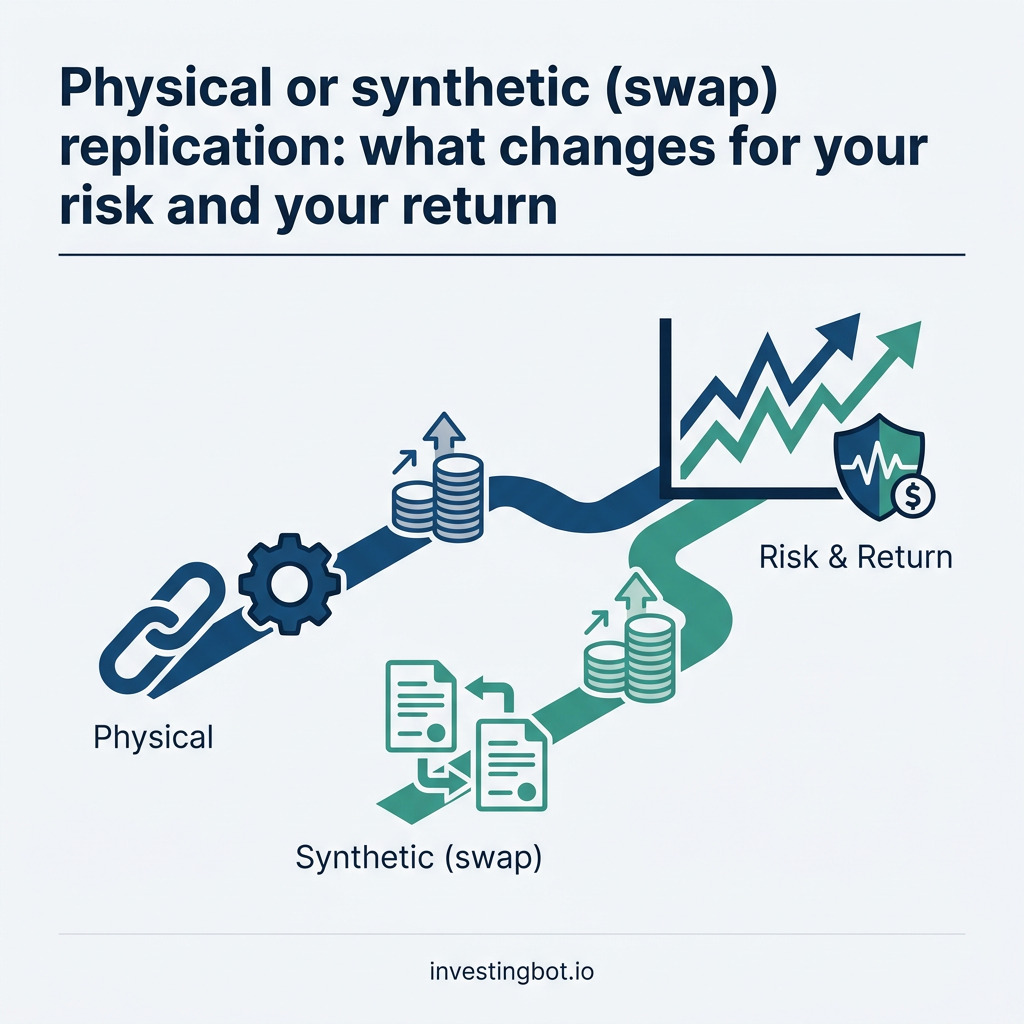
A physically replicated ETF buys the stocks in its index; a synthetic one buys other securities and gets a bank to pay it the index return through a contract called a swap. The first exposes you to the securities, the second to the bank as well, within strict limits. On our data, on the S&P 500 a synthetic ETF returned more than a physical one in every year from 2018 to 2025, for a tax reason rather than any skill of the manager.
Physical and synthetic replication in a nutshell
An ETF promises to track an index. There are two ways to keep that promise:
- physical replication: the fund buys the stocks or bonds in the index, all of them (full replication) or a representative subset (sampling);
- synthetic replication: the fund buys a different basket of securities and signs a swap with one or more banks, a contract in which the bank pays it the index return and the fund hands over the return of its own basket.
For the person buying the shares, the expected result is the same: the index return minus costs. What changes is what sits inside the fund and who you are exposed to.
How a swap works
Take a synthetic S&P 500 ETF. With investors’ money the fund buys, for example, large European and Japanese stocks. Then it makes a deal with a bank: every day the fund pays the bank the difference between the return of that basket and the return of the S&P 500, or receives it, depending on which did better. The fund’s value thus follows the index even though it holds no American stock at all.
The new risk is that the bank does not pay. That is why the swap is reset often, by settling the difference, and the European rules for UCITS funds set a cap: exposure to a single counterparty of an over-the-counter derivative cannot exceed 10% of the fund’s assets when the counterparty is a bank, and 5% in other cases (Article 52 of Directive 2009/65/EC). If the bank failed, the fund would still hold its own basket of securities.
Our data: how common synthetic replication is
Our archive of UCITS funds, updated in early October 2026, contains 3,876 ETFs; for 3,108 of them the issuer states the replication method. Synthetic ones number 441, or 14.2%. The share varies widely by asset class:
- commodities: 56 funds out of 85, or 65.9%. A UCITS fund cannot hold oil or wheat: to track a commodity index it almost always uses a swap;
- equities: 353 out of 1,996, or 17.7%;
- bonds: 31 out of 987, or 3.1%.
A handful of issuers make up almost the whole synthetic market: Amundi has 172, Invesco 75, Xtrackers 63, UBS 48. Among the dollar ETFs without currency hedging that name the S&P 500 as their index, 7 are physical and 7 synthetic, with the same median annual cost: 0.07%.
The S&P 500 case: sixteen years side by side
We compared three S&P 500 ETFs listed in London, all accumulating and in dollars: one physical, the iShares Core S&P 500 (TER 0.07%), and two synthetic, the Invesco S&P 500 (TER 0.05%) and the Xtrackers S&P 500 Swap 1C (TER 0.15%). These are market prices, adjusted for share splits.
| Year | Physical iShares | Synthetic Invesco | Synthetic Xtrackers | Gap Invesco-iShares |
|---|---|---|---|---|
| 2018 | -6.23% | -5.98% | -5.89% | +0.25 |
| 2019 | 31.63% | 31.96% | 31.91% | +0.33 |
| 2020 | 17.62% | 17.89% | 17.93% | +0.27 |
| 2021 | 29.35% | 29.64% | 29.63% | +0.29 |
| 2022 | -18.72% | -18.53% | -18.61% | +0.19 |
| 2023 | 26.74% | 27.00% | 26.92% | +0.26 |
| 2024 | 25.25% | 25.56% | 25.39% | +0.31 |
| 2025 | 17.45% | 17.58% | 17.45% | +0.13 |
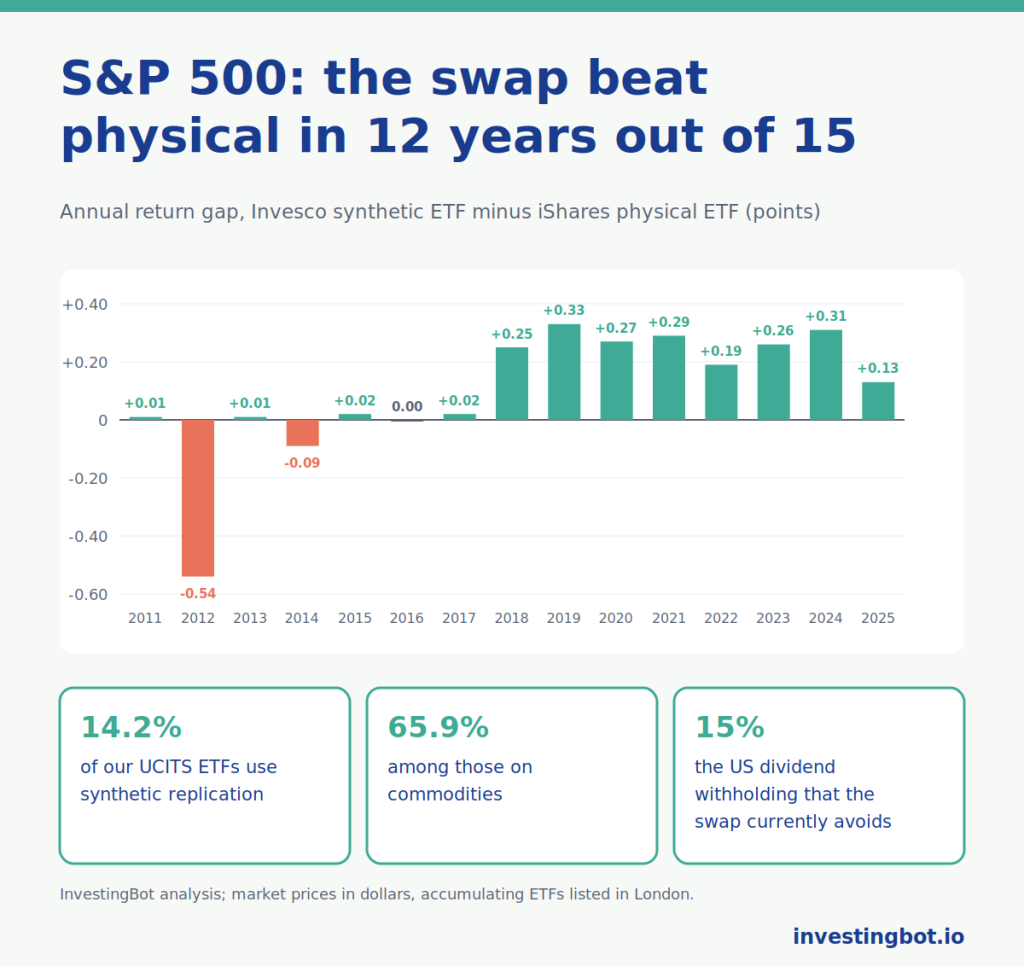
From 22 September 2010 to 16 October 2026 the physical fund returned 762.0% (14.35% a year), the synthetic Invesco 773.9% (14.45% a year) and the synthetic Xtrackers 778.9% (14.49% a year). In the full years from 2011 to 2025 the synthetic Invesco beat the physical fund in 12 out of 15, and in every one from 2018 onwards.
Why synthetic returns more on US stocks
The gap does not come from the manager’s skill: it comes from taxes on dividends. The United States withholds a tax on dividends paid to foreign investors. A physical ETF domiciled in Ireland, thanks to the treaty between the two countries, pays 15% on the dividends of the US stocks it owns. The swap, under current US tax rules (section 871(m) of the tax code), can pay the fund the index return without that withholding, provided the index has a deep and liquid futures market, as the S&P 500 does.
With an index dividend between 1.3% and 2% a year, 15% is worth between 0.2 and 0.3 points of return: the same order of magnitude as the gaps in the table. Three caveats: the advantage applies to US stocks and not to every index; it rests on a rule that could change; and it does not concern the taxes you pay as an investor, which depend on the country you live in.
Counterparty risk: how much it really weighs
Synthetic replication was at the centre of a debate after the 2008 crisis. Srichander Ramaswamy, an economist at the Bank for International Settlements, in «Market structures and systemic risks of exchange-traded funds» (BIS Working Paper no. 343, 2011) warned precisely about ETFs that replicate with derivatives: as they grew, the link between the fund and its bank counterparty could become a channel of risk for the system. In the same year the Financial Stability Board published a note on the same issues.
Since then the rules have tightened: a 10% cap on each counterparty, collateral posted by the bank, an obligation to disclose the basket and the counterparties. Two things remain true:
- counterparty risk exists, but it is limited to part of the assets: if the bank defaults the fund keeps its basket of securities, which however is not the index basket;
- many physical ETFs have a counterparty too: those that lend the securities in their portfolio to other intermediaries to earn a fee. The risk is similar and should be looked at the same way.
When one or the other makes sense
- US stocks: in European funds, synthetic has a structural tax advantage, as long as the rule stays as it is.
- Commodities: in UCITS funds synthetic replication is almost unavoidable; the alternative is ETCs, which are debt securities and not funds.
- Markets that are hard to buy: some emerging or niche indices are expensive to replicate physically; a swap can stay closer to the index.
- Bonds: physical replication is the norm; a synthetic bond fund is an exception to understand well before buying.
- If you only want the index securities in the portfolio, with no contracts with banks, choose a physical fund that does not lend its securities, or lends few: the prospectus and the issuer’s pages say so.
The stated cost is not enough to choose: what counts is the actual gap between the fund and its index over time, as we explain in the guide on how to choose between nearly identical ETFs.
Where to find this on InvestingBot
In the ETF Catalogue each fund’s page has a Replication field, filled in when the issuer states it, and the comparison with the other ETFs on the same index. Today the catalogue shows funds listed in the United States, where synthetic replication is found mostly in leveraged and inverse products. For European funds the guide to UCITS ETFs applies: before buying, check on the issuer’s page the replication method, the swap counterparties and securities lending.
In short
- Physical replication buys the index securities; synthetic replication obtains their return through a swap with a bank.
- In our UCITS archive synthetic funds are 14.2%, but 65.9% among commodities and 3.1% among bonds.
- On the S&P 500 the synthetic Invesco beat the physical iShares in every year from 2018 to 2025, by 0.13-0.33 points.
- The advantage comes from the 15% withholding on US dividends, which the swap currently avoids.
- Counterparty risk exists but is capped at 10% of assets per bank, and it also concerns physical funds that lend securities.
What is a synthetic ETF?
It is an ETF that does not buy the index securities: it buys a basket of other securities and signs a swap with a bank, which pays it the index return in exchange for the return of the basket.
Is a synthetic ETF riskier than a physical one?
It adds the risk that the bank counterparty does not pay. In UCITS funds this risk is capped at 10% of assets per bank, and the fund keeps its basket of securities. Physical ETFs that lend their securities also have a counterparty.
Why does a synthetic S&P 500 ETF return more?
Because the swap, under current US tax rules, delivers the index return without the 15% withholding that a physical Irish fund pays on US dividends. On our data the advantage was 0.13-0.33 points a year from 2018 to 2025.
How many European ETFs use synthetic replication?
In our UCITS archive, 441 funds out of the 3,108 that state their replication method: 14.2%. They are 65.9% of commodity funds, 17.7% of equity funds and 3.1% of bond funds.
What happens if the swap bank fails?
The fund loses its claim on the bank, which by law cannot exceed 10% of assets, and keeps the basket of securities it owns. The share value can fall and stop tracking the index until the swap is replaced.
Does the tax advantage of synthetic apply to me?
It concerns the taxes the fund pays on US dividends, not those you pay as an investor, which depend on the country you live in and on the type of fund. And it rests on a US rule that could change.