



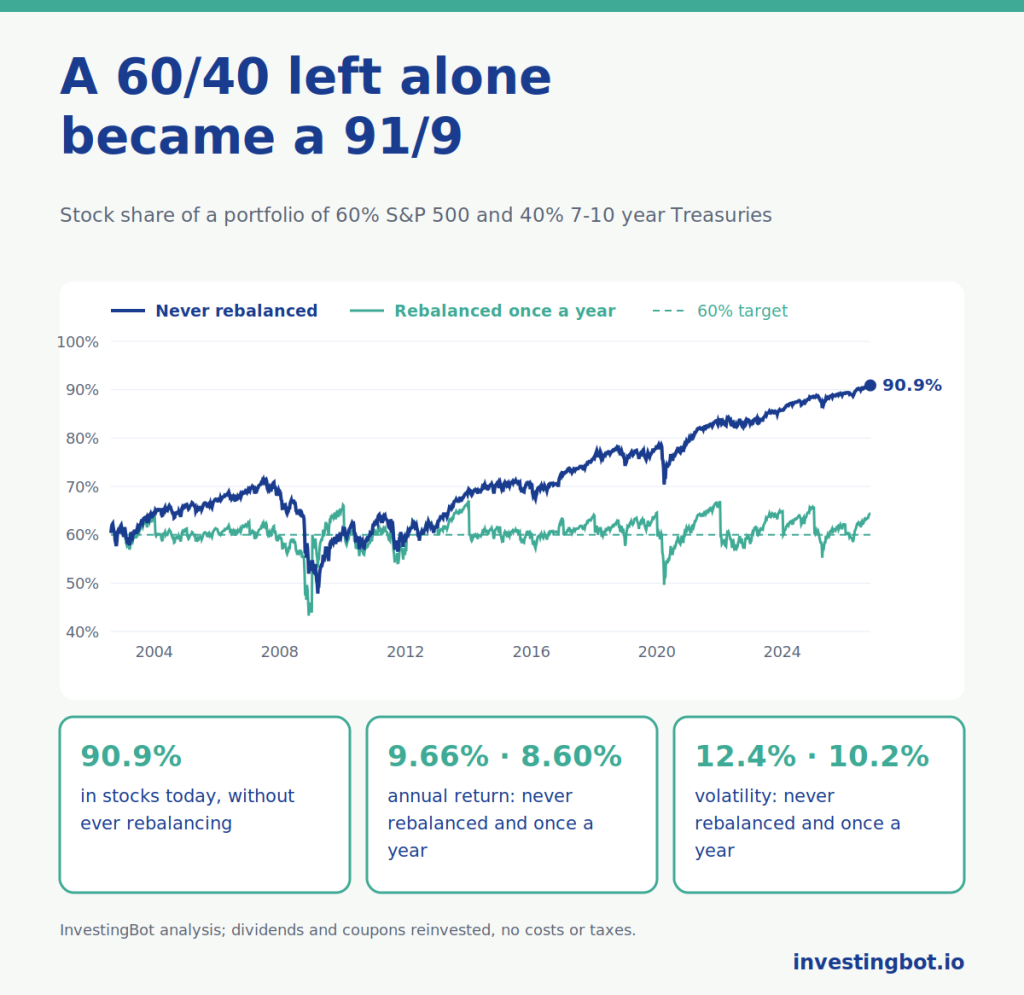
Rebalancing means bringing your portfolio back to the weights you chose, selling some of what has grown most and buying what has fallen behind. It is not about earning more: it is about not ending up with a level of risk you never chose. On our data, a portfolio of 60% stocks and 40% bonds left alone since 2002 is today 90.9% in stocks.
What rebalancing is, in a nutshell
When you build a portfolio you choose a split, for example 60% stocks and 40% bonds. Over time the two parts return different amounts and the weights drift. Rebalancing means bringing them back to the starting point:
- by selling part of whatever is above its weight and buying whatever is below;
- or by directing new contributions, dividends and coupons to the part that has fallen behind, without selling anything.
The starting split reflects how much risk you are willing to bear. If you let it drift, the market makes that choice for you.
Why a portfolio changes on its own
Over the long run stocks tend to return more than bonds, so in a portfolio left alone their weight grows. In our 60/40 started in July 2002 the stock share was 68.3% at the end of 2007, fell to 53.7% at the end of 2008 with the crash, rose to 78.3% at the end of 2019 and is 90.9% today.
Nobody decided it, but the portfolio became something else: a 91/9 swings far more than a 60/40 and loses far more in a crash. How much that difference can weigh is what we measured in our article on beta and drawdown.
Our data: a 60/40 from 2002 to today
We simulated a portfolio of 60% US stocks (S&P 500) and 40% 7-10 year US Treasuries, with dividends and coupons reinvested, from July 29, 2002 to October 12, 2026: 24.2 years. We compared four rules, without costs or taxes.
| Rule | Annual return | Volatility | Maximum loss | Rebalances | Total share traded |
|---|---|---|---|---|---|
| No rebalancing | 9.66% | 12.4% | -33.2% | 0 | 0% |
| Once a year | 8.60% | 10.2% | -30.2% | 24 | 82.7% |
| Once a month | 8.57% | 10.5% | -32.2% | 291 | 279.8% |
| When the gap exceeds 5 points | 8.72% | 10.8% | -31.7% | 22 | 115.6% |
The share traded is the sum, across all years, of the part of the portfolio sold to rebalance. The maximum losses all date from 2008; in 2022, when stocks and bonds fell together, the never-rebalanced portfolio lost 23.0% and the one rebalanced once a year 21.0%.
Rebalancing is not about earning more
The never-rebalanced portfolio returned more: 9.66% a year against 8.60%. It is not a paradox. Over these 24 years stocks returned far more than bonds, and whoever let them grow ended up with more and more stocks. They also had more risk: volatility of 12.4% against 10.2% and a deeper maximum loss.
This is the conclusion of a classic study: André Perold and William Sharpe, winner of the 1990 Nobel prize in economics, in “Dynamic Strategies for Asset Allocation” (Financial Analysts Journal, 1988), showed that bringing a portfolio back to fixed weights does better in markets that swing without direction and worse in those with a long trend, where letting it run pays off. Nobody knows in advance which of the two markets lies ahead: that is why rebalancing is judged on risk, not on return.
How often: calendar or threshold
Rebalancing often does not help. Once a month or once a year gave almost the same result, 8.57% against 8.60%, but monthly rebalancing required 291 trades against 24 and turned over more than three times as much of the portfolio: 279.8% against 82.7%. Every trade has a cost, and often a tax effect too.
The threshold rule acts only when needed: with a threshold of 5 points from 60%, 22 trades were enough in 24 years, and the stock weight never strayed more than 6.5 points from 60%. And it tends to buy in moments of panic: between January 2008 and March 2009 it bought stocks four times, the last on March 5, 2009, four days before the market bottom, and sold them again in April and August 2009 after the rebound. In 2020 it bought on March 9, in the middle of the crash.
Rebalancing with fewer sales (and less tax)
In many jurisdictions, selling an investment at a gain triggers a tax on the capital gain, while in others there are accounts or regimes where internal moves do not trigger it. The rules change from country to country, but the principle holds everywhere: every sale you avoid is a cost you do not pay. A few routes:
- new contributions go to the underweight part, instead of always being split in the same proportions;
- dividends and coupons are reinvested where needed, instead of in the same instrument that paid them;
- when you have to sell, if your rules allow it, it pays to do so inside accounts where moves are not taxed, or to sell first the positions with the smallest gain.
Contributions are not always enough, though. In our simulation, with a monthly contribution equal to 1% of the initial capital, all directed to the underweight part, the portfolio stayed within 5 points of 60% only 47.2% of the time, and today it is 22.4 points off: as capital grows, contributions become small relative to it. They work well in the early years of a regular savings plan, as we explain in our guide to dollar-cost averaging; later, some selling becomes unavoidable.
The right questions before rebalancing
- Has the weight left the band I chose? If the gap is small, there is nothing to do.
- Can I rebalance with new money? Contributions, dividends and coupons are the cheapest way.
- How much does selling cost me? Fees, the gap between buying and selling price, and taxes should be weighed before acting.
- Is my split still the right one? If your horizon or your risk tolerance has changed, the destination needs changing, not just rebalancing.
- Am I rebalancing or chasing the market? Rebalancing follows rules set in advance; shifting weights because something is rising is something else.
Where to find these tools on InvestingBot
On the Portfolio Structure page you will find the portfolio models with their management rules: rebalance once or twice a year on a calendar, or when an asset class drifts more than 5 points from its weight, and do it first with new contributions, to avoid selling. In My portfolios you see the current split of each portfolio next to the target stock share of your profile, so you notice when the weights have drifted.
In short
- Rebalancing means bringing the portfolio back to the chosen weights, to control risk.
- A 60/40 left alone since 2002 is 90.9% in stocks today.
- Not rebalancing returned more over these 24 years, but with more volatility and deeper losses.
- Rebalancing every month gave the same result as once a year, with 291 trades instead of 24.
- A 5-point threshold was enough with 22 trades in 24 years.
- Contributions, dividends and coupons let you rebalance with fewer sales, but over time they are not enough on their own.
What is portfolio rebalancing?
It is the operation that brings the different parts of a portfolio back to the weights chosen at the start, by selling what has grown beyond its weight or by directing new money to what has fallen behind.
Does rebalancing earn more?
Not necessarily. On our data, a 60/40 never rebalanced since 2002 returned 9.66% a year against 8.60% for the one rebalanced once a year, because stocks returned more than bonds. Rebalancing serves to keep risk at the chosen level.
How often should you rebalance?
There is no need to do it often. Rebalancing every month gave almost the same result as once a year, with 291 trades against 24. A threshold rule, which acts when a weight drifts more than 5 points, required 22 trades in 24 years.
How do you rebalance without selling?
By directing new contributions, dividends and coupons to the underweight part. It works well as long as contributions are large relative to the portfolio; in our simulation, over time, on their own they kept it within 5 points of its weight only 47.2% of the time.
Does rebalancing have a tax cost?
It depends on where you live and how you hold your investments. In many jurisdictions selling at a gain triggers a tax on the capital gain, in others there are accounts where internal moves are not taxed. That is why it pays to rebalance first with incoming cash flows and to sell as little as possible.
What happens if I never rebalance?
The portfolio changes on its own. On our data a 60/40 started in 2002 became a 91/9, with volatility of 12.4% against 10.2% and a maximum loss of 33.2% in 2008. Risk grows without anyone having decided it.