



An accumulating ETF automatically reinvests dividends and coupons inside the fund; a distributing one pays them into your account, usually every quarter or every six months. The underlying portfolio is the same, the total return before tax is the same, and almost always the cost is the same too: in our data, among the 493 funds that come in both versions, the TER is identical in 472 cases (96%). So the choice is not about how much you earn, but about when you receive the money, what you do with it and how it is taxed where you live.
What really changes between accumulating and distributing
Many funds come in two almost identical “share classes”: same manager, same index, same holdings. Only one rule changes, the one about income, meaning the dividends from stocks or the coupons from bonds that the fund collects.
- Accumulating (often marked “Acc” or “C” in the name): the fund reinvests the income by buying more securities. You receive nothing, but each share is worth a little more.
- Distributing (“Dist”, “Dis” or “D”): the fund pays the income out to investors. You receive cash, and the value of the share drops by the same amount on the ex-dividend date.
In our universe of 3,876 UCITS ETFs, 2,432 are accumulating and 1,244 distributing: almost two out of three among those for which the data is available. Among equity funds the lead of accumulating classes is even clearer: 1,647 against 683.
Same fund, same cost: what our data shows
We looked for funds offered in both versions, meaning pairs with the same issuer, the same index, the same currency and the same currency hedging, if any. There are 493. In 472 the annual cost (TER) is identical; in the few cases where it differs, the gap does not always point the same way: sometimes the distributing class is more expensive, sometimes the accumulating one.
The practical consequence is simple: choosing the share class almost never costs you anything. If two classes of the same fund have different costs, it is worth checking, because even a few basis points a year add up over a long horizon, as we showed in the article on ETF costs over twenty years. And if you find the same index offered by different issuers, the criteria for choosing are in the guide on how to choose between identical ETFs.
Each ETF’s page shows its income policy; in the table of alternatives on the same index, sorted by TER, you can see at a glance which class accumulates and which distributes.
Why the price of a distributing ETF “falls” on the payout
On the day the fund pays out its income, the value of the share drops by the amount distributed. It is not a loss: the money has moved from the fund to your account. Before the payout you had a share worth 100; afterwards you have a share worth 99 and 1 in cash.
That is why comparing two classes by looking only at the price chart is misleading: the distributing one always seems to “return less”, because its chart loses at every payout what you have collected. The right comparison is on total return, meaning price plus reinvested income. On that measure, two classes of the same fund with the same cost deliver practically identical results before tax.
A dividend is not a gift
That a dividend does not create wealth out of nothing is one of the best-known results in finance. Merton Miller (University of Chicago) and Franco Modigliani (later at MIT), both Nobel laureates in economics, showed in “Dividend Policy, Growth, and the Valuation of Shares” (Journal of Business, 1961) that in a market without taxes or transaction costs, the way a company pays out its earnings does not change shareholder value: what leaves as a dividend leaves the value of the share.
Yet many investors think of the dividend as extra income. Samuel Hartzmark (then at the University of Chicago Booth School of Business) and David Solomon (Boston College), in “The Dividend Disconnect” (Journal of Finance, 2019), documented what they call the “free dividends fallacy”: investors and even funds treat dividends and price changes as two separate things, and rarely reinvest dividends. With an ETF the reasoning is the same: the distributing class does not give you more, it gives you earlier a part of what is already yours.
When accumulating makes sense
Accumulating is the natural choice when you are in the phase where capital needs to grow and you do not need a regular income.
- Compounding without friction: income goes back to work immediately, without you doing anything and without purchase fees.
- No leftover cash: with distributing classes, small amounts often sit idle in your account because they are not enough to buy a whole share.
- Discipline: what does not reach your account does not get spent. For anyone following a regular savings plan, it is the simplest way to let time do the work.
- Possible tax advantages, where the rules defer the tax until you sell (see below).
When distributing makes sense
Distributing makes sense when a regular income is exactly what you need, for example in retirement or to top up another source of income.
- Cash flow without selling: you receive money without having to decide each time how many shares to sell.
- A simple spending rule: Hersh Shefrin and Meir Statman, both of Santa Clara University, in “Explaining Investor Preference for Cash Dividends” (Journal of Financial Economics, 1984), explained the preference for dividends partly as a self-control device: spending only what the portfolio pays out protects the capital from your own temptations. It is a psychological reason, not a financial one, but for many people it is real.
- Possible tax advantages in some jurisdictions, or for investors with a low rate on investment income.
The downside: distributions are not as steady as a salary. They depend on the earnings and coupons of the underlying holdings and can fall precisely in the difficult years.
Taxes: it depends on where you live
This is often the deciding factor, and the one with no answer that holds everywhere. In some jurisdictions distributed income is taxed when you receive it, while with accumulating classes the tax is only paid when you sell your shares: the deferral lets the part that would otherwise go to tax keep working too. In others the difference disappears, because the law taxes reinvested income every year as well, or a deemed return of the fund. In others still, investment income enjoys rates or allowances that make distributing classes more convenient.
One thing, however, applies to both classes: the withholding taxes the fund pays on foreign dividends (for example on US stocks) depend on the fund’s domicile, not on the share class. The accumulating and distributing classes of the same fund bear them in the same way. Before choosing, check the rules in your country or ask a tax adviser.
How to choose in practice
- Do you need an income today? If not, accumulating is almost always the simplest route.
- How are the two classes taxed where you live? If one is clearly more favourable, that often decides it.
- Do the two classes cost the same? In 96% of cases they do; if not, check the difference.
- Is the traded volume sufficient? A very small class may have a wider bid-ask spread.
- Remember you can change your mind: switching from one class to the other means selling and buying again, with costs and, in many countries, taxes. Better to choose well at the start.
In summary
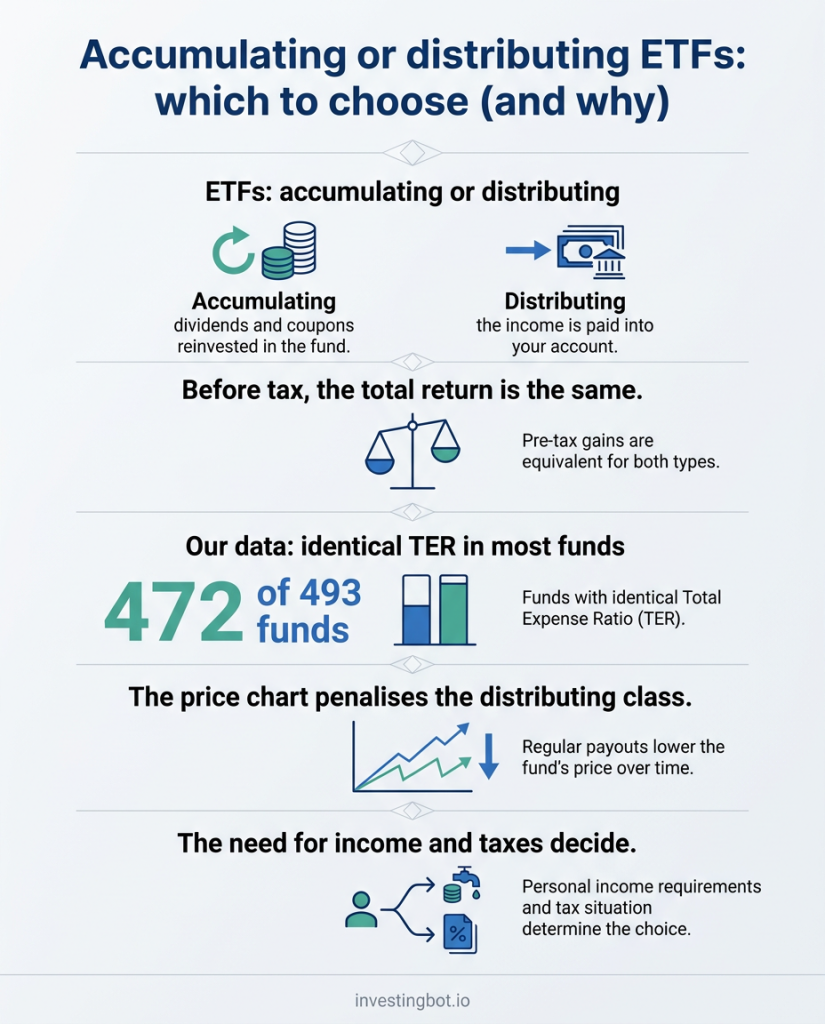
- Accumulating and distributing classes differ only in what happens to the income: reinvested in the fund or paid into your account.
- Before tax the total return is the same: the distributed dividend comes out of the value of the share.
- In our data the TER is identical in 472 of the 493 funds offered in both versions.
- The price chart always penalises the distributing class: compare total return instead.
- Accumulating is the natural choice for growing capital; distributing is for those who need an income.
- Taxes often decide, and they vary from country to country: check the rules that apply to you.
What is the difference between accumulating and distributing ETFs?
An accumulating ETF reinvests dividends and coupons inside the fund, so the value of the share grows; a distributing one pays them periodically into the investor’s account. The underlying portfolio and, almost always, the annual cost are the same.
Does an accumulating ETF return more?
Not before tax: the total return of the two classes of the same fund is practically identical, because the distributed income comes out of the value of the share. It can return more after tax in countries where accumulating classes defer the tax until you sell.
Why does the price of a distributing ETF fall?
On the payout date the value of the share drops by the amount distributed, which arrives in your account. It is not a loss: the money moves from the fund to you. To compare two classes you need to look at total return, not just the price.
Do distributing ETFs cost more?
Hardly ever. In our data, among the 493 funds available in both versions, the TER is identical in 472 cases; in the few where it differs, the gap does not always go against the distributing class.
Which is better for a regular savings plan?
Usually the accumulating class: income is reinvested immediately and without fees, no small amounts sit idle in the account and there is no temptation to spend them. It is still worth checking how the two classes are taxed in your own country.
Can I switch from one class to the other?
Yes, by selling the shares of one class and buying those of the other. It involves trading costs and, in many countries, tax on realised gains: that is why it pays to choose carefully at the start.