



Many trading apps charge no commission. But someone pays for a free service: often it is a large market firm that pays the broker to receive your orders and execute them itself. It is called payment for order flow. In the United States it is legal and disclosed; in the European Union it is banned. The question that matters for investors is just one: at what price is your order executed, and who earns the difference.
Payment for order flow, in a nutshell
When you buy a share through an app, the order does not necessarily go to an exchange. The broker can pass it to a wholesaler, a large trading firm that buys and sells on its own account and pays the broker a small amount for each order in return. The wholesaler earns on the difference between the buying and selling price, the spread; the broker earns the payment and can charge no commission.
The conflict is obvious: the broker must seek the best possible price for the client, but it is paid by whoever executes the order. The higher the payment, the more the broker is tempted to send orders to whoever pays best, not to whoever executes best.
How it works, and why it is legal
In the United States the practice is allowed on two conditions. First, the broker must disclose the payments it receives, in public periodic reports showing where it sends orders and how much it collects. Second, it must meet its duty of best execution, that is, seek the most favourable price for the client.
The wholesaler often executes the order at a price slightly better than the one quoted on the exchange at that moment, the price improvement. That is the argument in favour: the client pays no commission and gets a slightly better price. The argument against: that improvement could be larger if the broker did not pocket part of the value of the orders.
A practice that dates back to the eighties
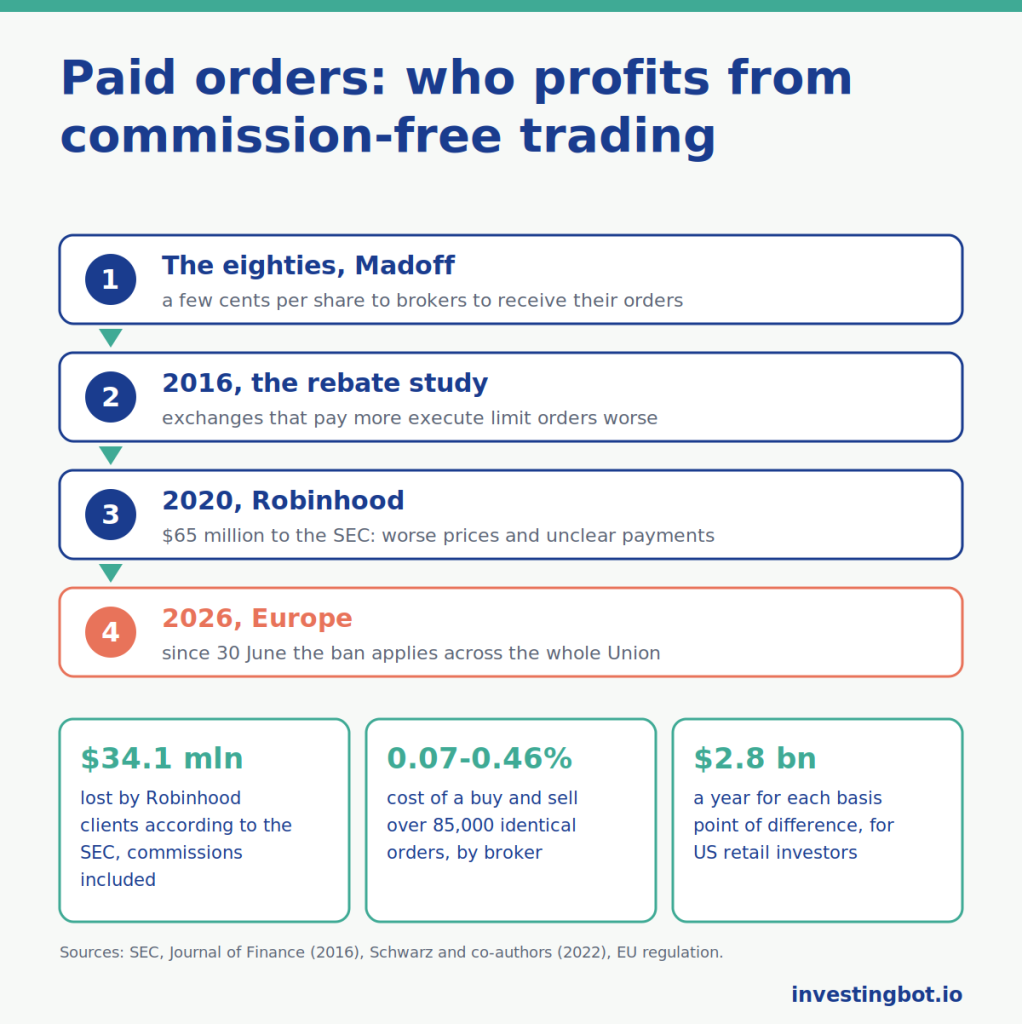
Among the first to practise it systematically was Bernard Madoff, through his market-making business: he paid brokers a few cents per share to receive their orders. That part of his business was legal and separate from the fraud for which he was convicted in 2009. The model then spread, and today a few large trading firms execute a significant share of American retail investors’ orders away from the exchanges.
The Robinhood case, 2020
On 17 December 2020 the SEC, the US markets regulator, settled charges against Robinhood, the app that made commission-free trading popular. The SEC alleged that between 2015 and 2018 the company had not clearly disclosed to clients that its main source of revenue was payments for their orders, and that precisely because of the very high payments it demanded its clients had received worse prices than at other brokers.
According to the SEC, even after counting the commission savings, clients had lost about $34.1 million. Robinhood paid $65 million, without admitting or denying the charges, and agreed to an independent consultant on its procedures. Here the line was crossed from legal to unlawful: not because of the payment itself, but because of how it had been disclosed and how orders were executed.
The hidden conflict: exchange rebates
The conflict is not only about orders sold to wholesalers. Many American exchanges pay a rebate to whoever brings orders that wait to be executed, the limit orders, and charge whoever executes against them. A broker can therefore choose the exchange that pays the highest rebate, even if the client’s order is less likely to be filled there.
This is the grey area: no rule explicitly prohibits it, but the duty of best execution says the client’s interest is what counts, not the broker’s. The study cited below measured how much this choice costs clients.
What the research says
Robert Battalio and Shane Corwin (University of Notre Dame) and Robert Jennings (Indiana University), in «Can Brokers Have It All? On the Relation between Make-Take Fees and Limit Order Execution Quality» (Journal of Finance, 2016), showed that some large American brokers sent limit orders to the exchanges paying the highest rebates, and that execution quality there was worse. The title states the conclusion: the broker cannot have it all, collecting the highest rebate and getting the best execution for the client.
A 2022 study by Christopher Schwarz and Philippe Jorion (University of California, Irvine), Brad Barber (University of California, Davis), Xing Huang (Washington University in St. Louis) and Terrance Odean (University of California, Berkeley), «The “Actual Retail Price” of Equity Trades», ran a direct experiment: about 85,000 identical orders, sent at the same moment through accounts at different commission-free brokers. The average cost of a buy and a sell, excluding commissions, ranged from about 0.07% to about 0.46% depending on the account. The authors estimate that each basis point of difference costs American retail investors about $2.8 billion a year. And an unexpected finding: the differences did not depend on the size of the order payments, but on how wholesalers treated each broker’s clients.
Europe and the United States: two opposite paths
The European Union chose a ban. The new financial markets rules, in force since 28 March 2024, prohibit brokers from receiving payments for routing retail client orders. Member states where the practice already existed could grant a transition period, only for domestic clients, which ended on 30 June 2026: since then the ban applies across the whole Union.
The United States took another path. Between 2022 and 2023 the SEC had proposed requiring brokers to send many retail orders to auction before executing them internally, but on 12 June 2025 it withdrew the proposal together with thirteen others. Disclosure obligations and the duty of best execution remain.
What this means for retail investors
Payment for order flow is not a scam, and the price obtained is often good. But «free» does not mean «without cost». For investors it means three things:
- the real cost of an order is the execution price, not just the commission: a few cents per share, over many orders, weighs more than a fixed commission;
- with market orders the conflict matters more: a limit order protects you from the worst price, even though it may not be filled;
- brokers publish where they send orders and how much they collect: in the United States these are mandatory periodic reports, in Europe a broker can no longer receive those payments.
How a shareholder can vote while risking nothing is told in the article on empty voting; how the debts of a company in crisis end up with someone who wants to take it over, in the one on vulture funds. On InvestingBot prices are delayed by 15-30 minutes and the time of every quote is always shown: they are enough to decide, but to execute you look at your own broker’s price.
At a glance
- With payment for order flow a wholesaler pays the broker to receive and execute clients’ orders.
- In the United States it is legal if disclosed and if the broker seeks the best price; in the European Union it is banned, fully since 30 June 2026.
- In 2020 Robinhood paid $65 million to the SEC: according to the charges its clients had lost $34.1 million through worse prices.
- Battalio, Corwin and Jennings showed that chasing exchange rebates worsens the execution of limit orders.
- Over 85,000 identical orders the cost ranged from 0.07% to 0.46% depending on the broker, with no link to the payments.
- For investors the real cost is the execution price, and a limit order protects against the worst price.
What is payment for order flow?
It is the payment a wholesaler makes to a broker to receive its clients’ orders and execute them on its own account. The wholesaler earns on the difference between the buying and selling price, the broker on the payment.
Is it legal?
In the United States yes, if the broker discloses it and meets the duty to seek the best price for the client. In the European Union it has been banned since 28 March 2024, and the last national exemptions expired on 30 June 2026.
Why can commission-free apps be free?
Because they earn in other ways: order payments, interest on clients’ cash, securities lending, paid services. The client pays no commission, but the price at which they buy or sell may be slightly less favourable.
What did Robinhood do?
According to the SEC it had not clearly disclosed to clients that it was paid for their orders, and its clients had received worse prices than at other brokers. In December 2020 it paid $65 million without admitting or denying the charges.
How can I protect myself?
By using limit orders instead of market orders, comparing the execution price with the one quoted at the time, and reading the reports in which the broker discloses where it sends orders and how much it collects.
Has the problem disappeared in Europe?
Payments for routing retail client orders are banned, but execution quality still needs checking: the broker must still seek the best price, and the overall cost also depends on commissions and currency conversion.