



The numbers you read at the end of a quarter are not always a neutral snapshot. A manager can tidy up the portfolio before clients see it, so-called window dressing, and a company can push its earnings just enough to beat analysts’ estimates by a penny. Most of these practices are legal, some sit in the grey area and a few are banned. For investors it matters to recognise them, because a tidied-up number tells you less than it seems.
Window dressing and earnings “above expectations” in brief
Window dressing is a portfolio’s shop window: before the date on which its holdings are disclosed, the manager sells the stocks that did badly and keeps or buys those that did well, so the published list looks better than the fund actually performed over the period.
Earnings management is the same idea applied to a company’s accounts: the timing of revenue recognition, provisions, expenses shifted from one quarter to another. The typical goal is not to disappoint on three thresholds: staying profitable, doing better than the year before and reaching analysts’ estimates, perhaps by just one cent per share.
The year-end shop window of pension funds
Josef Lakonishok (University of Illinois), Andrei Shleifer (Harvard), Richard Thaler (University of Chicago, 2017 Nobel laureate) and Robert Vishny (University of Chicago), in “Window Dressing by Pension Fund Managers” (American Economic Review, 1991), studied 769 US pension funds with $129 billion in assets: managers sell more than usual the stocks that have lost value, and they do so above all in the fourth quarter, when sponsors examine the portfolios closely.
It is legal: selling a stock is a management decision. But anyone who looks only at the year-end list sees a tidier portfolio than the one that produced the returns. Some later studies also attribute these moves to tax reasons, so the phenomenon exists but its size is debated.
The last minute of the quarter
There is a more aggressive version. Mark Carhart (Goldman Sachs Asset Management), Ron Kaniel (University of Texas), David Musto (University of Pennsylvania) and Adam Reed (University of North Carolina), in “Leaning for the Tape” (Journal of Finance, 2002), showed that some fund managers buy, in the last minutes of the quarter, stocks they already hold, to push up their closing price and therefore the value of the fund’s shares. The effect ranges from 0.5% a year for large-cap funds to more than 2% for small-cap ones, and the next day prices fall back.
Here we move into the illegal: buying at the end of the session to influence the closing price is a form of manipulation, banned in the United States and, in Europe, by the Market Abuse Regulation. Whoever buys into the fund that day pays an inflated price, whoever sells collects it.
Beating estimates by a penny
François Degeorge (Università della Svizzera italiana), Jayendu Patel (Boston University) and Richard Zeckhauser (Harvard), in “Earnings Management to Exceed Thresholds” (Journal of Business, 1999), found that companies manage earnings to clear three thresholds in order of importance: staying above zero, doing better than the year before and meeting market expectations. The data show very few results just below the threshold and many just above it, and companies that clear it by a whisker later perform worse than less suspect ones.
This is mostly grey area: accounting standards leave legitimate room for estimates, and using it to reach the extra cent is not a crime in itself. It becomes a problem when the estimates no longer have a documented basis.
How much value is sacrificed for one quarter
John Graham and Campbell Harvey (Duke University) with Shiva Rajgopal (now at Columbia Business School), in “The Economic Implications of Corporate Financial Reporting” (Journal of Accounting and Economics, 2005), surveyed 401 US financial executives. 78% admitted they would give up economic value to have smooth earnings, and 55% would avoid starting a very profitable investment if it meant missing the quarter’s estimates.
This is the less visible side of the phenomenon: the numbers are not doctored, the decisions are changed. Cutting research or advertising, postponing maintenance or pulling sales forward with discounts is legal, but it can cost shareholders more than the extra cent is worth.
The missing four
Joseph Grundfest and Nadya Malenko, in a study for Stanford’s Rock Center for Corporate Governance later published with Yao Shen in the Journal of Financial and Quantitative Analysis in 2023, looked at the tenth-of-a-cent digit of earnings per share for thousands of US companies. The 4 appears less often than any other digit: it is the point at which a small adjustment makes the figure round up to the next cent. The authors called the phenomenon “quadrophobia”, and companies that show it are more likely to restate their accounts later and to come under SEC investigation.
When it becomes illegal: the SEC cases
The SEC uses data analysis to look for exactly these signals. In September 2020 it settled the first two cases: Interface, a flooring manufacturer, paid $5 million and the bank Fulton $1.5 million, for unsupported accounting adjustments that had allowed them to meet analysts’ estimates. In August 2021 Healthcare Services Group paid $6 million: according to the SEC it had not accrued expected losses from some lawsuits, and so met estimates in quarters in which it would have missed them. Interface and Fulton settled without admitting or denying the charges.
What it means for the retail investor
A quarter above expectations is not proof of manipulation, and one below is not proof of honesty. But for investors this means three things:
- earnings that beat estimates by a penny, quarter after quarter, deserve a question: check whether operating cash flow grows as earnings do, or whether earnings are running on their own;
- a fund’s year-end holdings are a shop window: to understand how a manager works, what counts is returns over time and portfolio turnover, not the list of stocks on one particular day;
- be wary of fund price gains concentrated on the last day of the quarter: if a fund’s value rises at period end and falls the next day, that part of the return is not real.
How fake orders and inflated news move prices is covered in the article on spoofing and pump and dump; how commission-free apps sell your orders, in the one on paid orders. On InvestingBot each stock’s page shows, among the accounting quality indicators, the Beneish score, designed to flag financial statements that may have been inflated: it does not uncover manipulation, but it tells you where to look more carefully.
In summary
- Window dressing tidies up a portfolio before it is disclosed; earnings management pushes the accounts to clear a threshold.
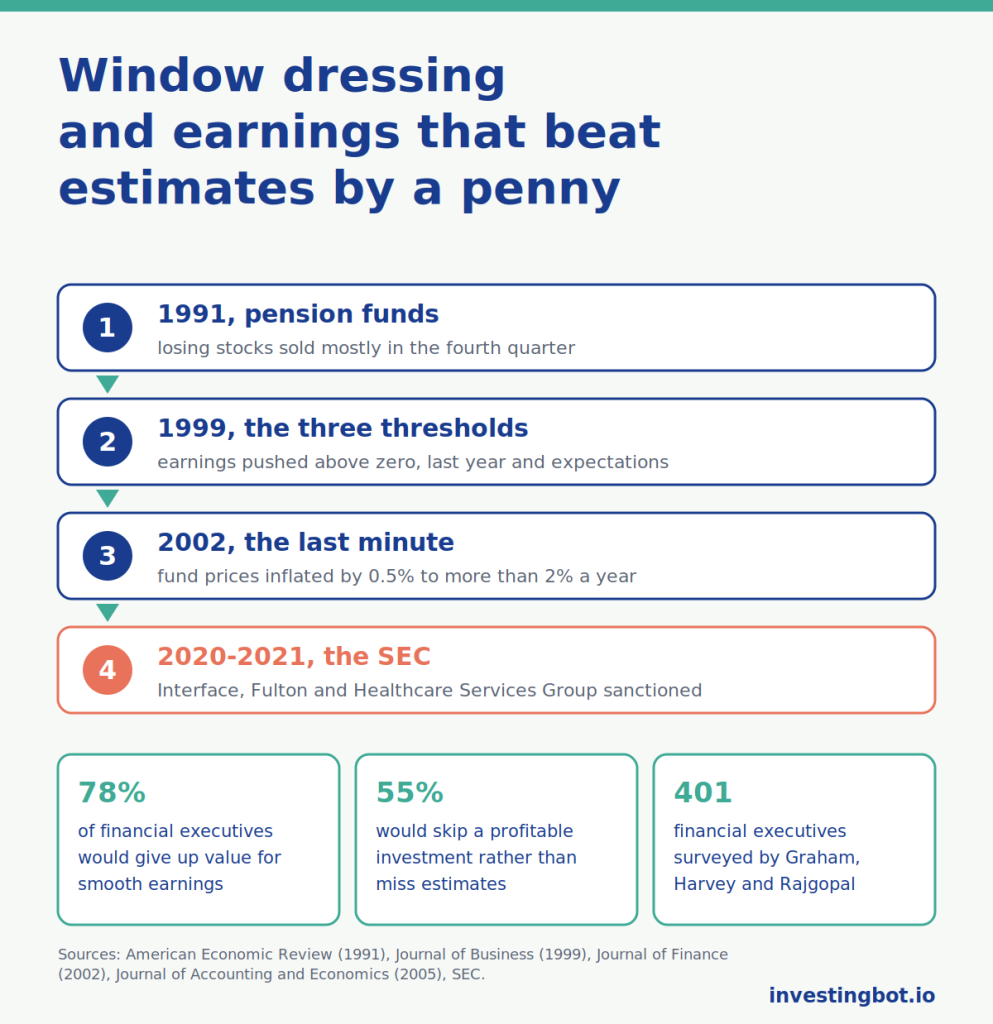
- In 1991 Lakonishok, Shleifer, Thaler and Vishny saw pension funds selling losing stocks mostly in the fourth quarter.
- Last-minute purchases inflate fund values by 0.5% to more than 2% a year, and they are banned manipulation.
- Companies manage earnings to stay above zero, above the previous year and above expectations.
- 78% of the 401 financial executives surveyed would give up value to have smooth earnings.
- The SEC sanctioned Interface, Fulton and Healthcare Services Group between 2020 and 2021 for meeting estimates with unsupported adjustments.
What is window dressing?
It is tidying up a portfolio before the date on which it is disclosed: the manager sells the stocks that did badly and keeps those that did well, so the published list looks better than the work done over the period.
Is window dressing illegal?
Selling or buying stocks before the end of the period is legal. It is illegal to buy in the last minutes to push up the closing price of stocks already in the portfolio, because that is a form of market manipulation.
Why do companies beat estimates by a penny?
Because the market punishes those who miss estimates, even by a little. Studies show companies use the room for estimates in accounting standards, and sometimes operating decisions, to land just above the threshold.
What is “quadrophobia”?
It is the fact that in the tenth-of-a-cent digit of earnings per share the 4 appears less often than any other digit. A Stanford study links it to adjustments that round up to the next cent, and finds it associated with later restatements.
What penalties has the SEC imposed?
In 2020 Interface paid $5 million and Fulton $1.5 million; in 2021 Healthcare Services Group paid $6 million. The charges concerned unsupported accounting adjustments that had allowed them to meet analysts’ estimates.
How can I tell that earnings are inflated?
No single signal is enough. It is worth checking whether operating cash flow follows earnings, whether the company always beats estimates by very little and whether accounting quality indicators are worsening.